
ITR Filing AY 2026-27
If you filed your Income Tax Return last year and think this year will be the same think again. ITR filing for AY 2026-27 comes with a set of meaningful changes to forms, disclosure requirements, and AIS reconciliation rules that every taxpayer salaried, self-employed, or an NRI must understand before hitting ‘Submit.’ Filing based on last year’s approach could mean missed disclosures, incorrect form selection, or delayed refunds. The good news? With the right guidance, navigating ITR filing for AY 2026-27 is completely manageable.
Expert Insight from Dr. Haresh Adwani for ITR filing AY 2026-27 Dr. Haresh Adwani, PhD in Commerce and law graduate at Adwani & Company, notes: “Every AY brings subtle but impactful form changes. In AY 2026-27, the CBDT has prioritised transparency in capital gains reporting and AIS-based reconciliation. Taxpayers who ignore these shifts risk scrutiny notices and that is entirely avoidable with proper preparation.”
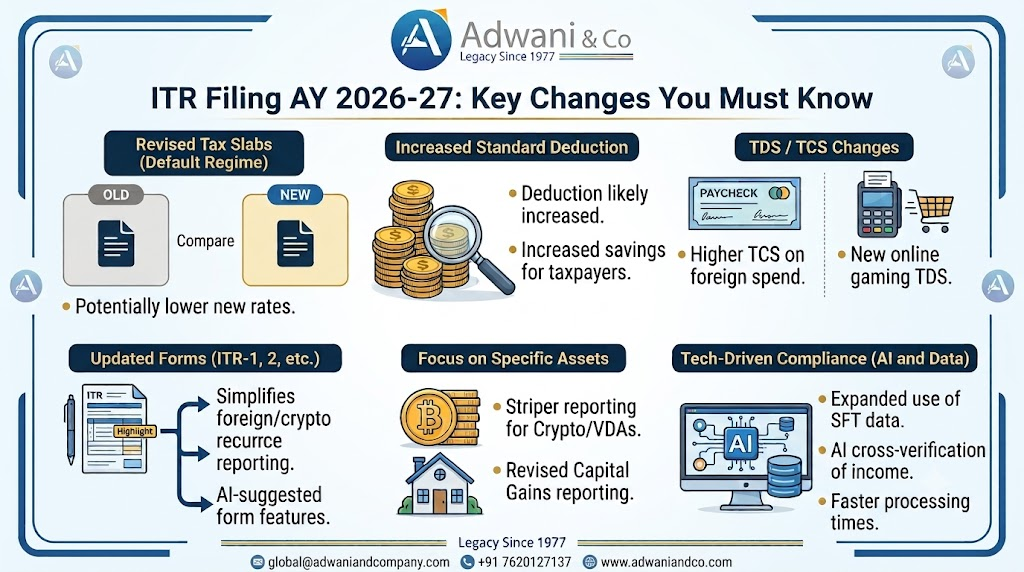
Why ITR Filing AY 2026-27 Is Different This Year
The Central Board of Direct Taxes (CBDT) notified revised ITR forms for AY 2026-27 with a clear intent: simplify compliance where possible, and tighten disclosure where it matters. The Income Tax Department’s Annual Information Statement (AIS) now captures a wider set of financial transactions from mutual fund redemptions and property sales to interest income and foreign remittances. When your ITR does not align with your AIS data, automated mismatch alerts are triggered, which can lead to assessment notices under Section 143(1) or 143(2) of the Income Tax Act.
Understanding what has changed in ITR filing for AY 2026-27 is therefore not optional it is the first line of defence against compliance risk.
Key Changes in ITR Forms for AY 2026-27
1. Capital Gains Reporting : Simplified at Last
One of the most welcome changes in ITR filing AY 2026-27 is the relaxation on capital gains reporting. Previously, taxpayers with even a modest Long-Term Capital Gain (LTCG) on listed equity shares or equity mutual funds were required to shift from the simple ITR-1 to the more complex ITR-2. This created unnecessary compliance burden for retail investors.
Under the revised rules, individuals with LTCG up to ₹1.25 lakh (the exemption limit under Section 112A) can continue using ITR-1 (Sahaj) without migrating to ITR-2. This is a significant simplification for the salaried middle class with basic equity investments.
2. Enhanced Disclosure Requirements
The AY 2026-27 ITR forms introduce expanded disclosure fields for deductions claimed under Chapter VI-A (such as 80C, 80D, 80G), exempt income categories, and tax credits. Taxpayers who claim deductions without adequate documentation are at greater risk of having those claims disallowed during assessment.
Dr. Haresh Adwani, whose firm has assisted hundreds of corporates and NRI clients with ITR compliance, advises: “Maintain investment proofs, premium receipts, and donation certificates well before you sit down to file. The new disclosure fields flag inconsistencies automatically.”
3. Separate Reporting for Old vs. New Tax Regime
AY 2026-27 ITR forms require taxpayers who opt for the old tax regime to furnish additional substantiation for their deductions and exemptions HRA, LTA, 80C investments, and so on. The default under the current framework is the new tax regime; choosing the old regime is an active election that must now be supported by proper documentation in the return itself. For business and professional taxpayers, Form 10-IEA filed on time is mandatory.
4. Granular Asset & Income Classification
The revised forms demand more precise categorisation of income sources distinguishing, for example, between interest from savings accounts, fixed deposits, and bonds. Similarly, asset disclosure schedules now require finer classification of moveable and immovable assets. This granularity helps the Income Tax Department cross-reference data received from banks, registrars, and financial intermediaries through SFT (Statement of Financial Transactions).
5. AIS and TDS Reconciliation : Non-Negotiable
Perhaps the single most important pre-filing step in ITR filing for AY 2026-27 is a thorough reconciliation of your Annual Information Statement (AIS) and Form 26AS with the income and TDS figures you plan to report. The Income Tax Department now matches ITR data against AIS in near real-time. Any unexplained discrepancy even a small TDS mismatch can trigger a notice.
Which ITR Form Should You Use for ITR filing AY 2026-27?
Selecting the correct ITR form is the foundation of a clean return. Below is a quick reference for common taxpayer profiles:
| ITR Form | Who Can Use It (AY 2026-27) | Key AY 2026-27 Change |
| ITR-1 (Sahaj) | Salaried individuals, LTCG up to ₹1.25 lakh | LTCG under ₹1.25L now eligible no forced shift to ITR-2 |
| ITR-2 | Capital gains, multiple properties, foreign assets | Granular asset classification; stricter deduction disclosure |
| ITR-4 (Sugam) | Presumptive income (Sec 44AD/44ADA/44AE) | Old regime taxpayers must furnish additional deduction proofs |
Internal Reference: Learn more about our ITR Filing Services for NRIs & Business Owners.
Practical Example: AIS Mismatch That Triggered a Notice
Real-World Scenario
Rajesh, a Pune-based IT professional, sold equity mutual fund units in FY 2025-26 and received LTCG of ₹80,000 well within the ₹1.25 lakh exemption. He filed ITR-1 but did not mention the capital gains transaction anywhere in his return, assuming the exemption meant no disclosure.
His AIS reflected the redemption proceeds of ₹4.8 lakh from the AMC’s SFT filing. The ITR showed no such transaction. An automated mismatch notice was issued under Section 143(1)(a).
Outcome: Had Rajesh correctly reported the LTCG under Schedule 112A (even as exempt income), no notice would have been generated. Disclosure ≠ tax liability, but non-disclosure = compliance risk. Key lesson: Even tax-exempt income must often be disclosed in AY 2026-27 ITR forms.
ITR Filing AY 2026-27 Pre-Filing Checklist
Before filing your ITR for AY 2026-27, work through this checklist recommended by Dr. Haresh Adwani and the compliance team at Adwani & Company:
- Download and review your AIS from the Income Tax e-filing portal (incometax.gov.in)
- Cross-check Form 26AS for TDS deducted by employers, banks, and other deductors
- Verify all interest income savings, FD, RD, and bonds
- Reconcile capital gains transactions with broker statements and AMC account statements
- Confirm tax regime choice (old or new) and gather supporting documents for the old regime
- Ensure all deductions claimed under 80C, 80D, 80G have documentary proof
- Verify foreign asset disclosures if applicable (bank accounts, shares held abroad)
- Check for any exempt income that still requires ITR disclosure
Read our detailed guide on AIS vs Form 26AS vs Form 16: ITR Filing Guide 2026-27
ITR Filing AY 2026-27 for NRIs: Additional Considerations
For non-resident Indians, ITR filing for AY 2026-27 carries additional layers of complexity. NRIs with India-sourced income rental income, capital gains, interest from NRO accounts, or professional fees must determine their residential status correctly under Section 6 of the Income Tax Act before choosing the applicable ITR form.
As per the Income Tax Department’s official guidance, residential status determines taxability of global vs. India-sourced income. FEMA compliance for repatriation and RBI’s guidelines on NRO/NRE accounts are equally important components of a complete NRI tax filing strategy.
Adwani & Company has a dedicated International Accounting and NRI tax practice, works with NRI clients across the US, UK, UAE, and Singapore. Learn more about our NRI Tax Filing Services.
Why Expert Guidance Matters for ITR Filing AY 2026-27
Dr. Haresh Adwani, with a PhD in Commerce, legal expertise, and decades of practice at Adwani & Company, often emphasises: “Tax filing is not a clerical task it is a legal declaration. Every number you submit has implications under the Income Tax Act and potentially the Black Money Act, FEMA, or the Benami Transactions Act. Getting it right the first time is always better than responding to notices later.”
Adwani & Company, established in 1977 and headquartered in Pimpri-Chinchwad, Pune, brings nearly five decades of experience in direct tax, international compliance, and business advisory. Our team assists individuals, HUFs, LLPs, private limited companies, and NRI clients with end-to-end ITR filing support from AIS reconciliation to final submission.
Key Takeaways: ITR Filing AY 2026-27
- LTCG up to ₹1.25 lakh on listed equities can now be reported in ITR-1 no need to shift to ITR-2
- Disclosure requirements are more stringent; even exempt income may need to be reported
- AIS reconciliation is critical the department matches ITR data against AIS automatically
- Old tax regime filers must substantiate deductions with documentation in the ITR itself
- NRIs must determine residential status correctly before selecting the ITR form
- Filing errors, mismatches, or omissions can attract Section 143(1) notices expert filing avoids this
Q1. What is the due date for ITR filing AY 2026-27?
For non-audit cases (salaried individuals, most individuals and HUFs), the due date for ITR filing for AY 2026-27 is typically 31st July 2026. For taxpayers whose accounts are subject to audit under the Income Tax Act or other laws, the due date is 31st October 2026. Belated returns can be filed until 31st December 2026, with applicable late fees under Section 234F.
Q2. Can I use ITR-1 if I have capital gains in AY 2026-27?
Yes if your Long-Term Capital Gains (LTCG) are from listed equity shares or equity mutual funds and the gains do not exceed ₹1.25 lakh (the Section 112A exemption threshold), you can now use ITR-1 for AY 2026-27. This is a new relaxation introduced in the revised forms. Any LTCG beyond this limit or Short-Term Capital Gains requires ITR-2.
Q3. Why does my ITR not match my AIS for AY 2026-27?
Your AIS aggregates data from multiple sources banks, mutual fund houses, stock brokers, property registrars, and more via the Statement of Financial Transactions (SFT) mechanism. If your ITR figures do not match AIS data, it is usually because income or transactions were omitted, or figures differ due to timing differences. Always download your AIS from the Income Tax portal (incometax.gov.in) and reconcile it before filing.
Q4. Is it mandatory to choose the new tax regime in ITR filing AY 2026-27?
No the new tax regime is the default for AY 2026-27, but it is not mandatory. Taxpayers can opt for the old tax regime to claim deductions and exemptions (HRA, 80C, 80D, LTA etc.). For individuals with business income, the election must be made via Form 10-IEA before the due date. Salaried individuals can make their choice in the ITR itself.
Q5. What happens if I file the wrong ITR form for AY 2026-27?
Filing an incorrect ITR form can render your return defective under Section 139(9). The Income Tax Department will issue a defective return notice, giving you 15 days to file a revised return using the correct form. Persistent non-compliance can lead to the return being treated as not filed, resulting in late fees and interest under Sections 234A, 234B, and 234C.
Q6. Do NRIs need to file ITR in India for AY 2026-27?
NRIs are required to file an ITR in India for AY 2026-27 if their total India-sourced income exceeds the basic exemption limit (currently ₹2.5 lakh for non-resident individuals, irrespective of age) or if they have capital gains from Indian assets, regardless of the amount. Filing is also advisable even below the threshold for TDS refunds on NRO interest or rental income.
Conclusion: File Smart, File Right for AY 2026-27
ITR filing for AY 2026-27 is more than an annual compliance checkbox it is a financial and legal declaration that carries real consequences. The changes introduced this year in capital gains reporting, AIS reconciliation, old vs. new tax regime disclosures, and asset classification mean that a copy-paste approach from last year is a recipe for errors.
As Dr. Haresh Adwani and the team at Adwani & Company consistently advise clients take the time to review your AIS, verify all income sources, select the correct ITR form, and ensure every deduction claimed is properly documented. Doing so not only keeps you legally compliant but also protects your refunds and avoids costly notices.
Whether you are a salaried professional in Pune, a business owner filing under presumptive taxation, or an NRI with rental income from Indian property the right guidance makes all the difference.
About the Author
Nidhi Adwani
Nidhi Adwani is the Human Resources Manager at Adwani & Co. She is a Law Graduate and holds an MBA in Human Resources. She manages recruitment, employee engagement, team development, workplace culture, and the firm’s social media and content activities. Passionate about people and organizational growth, she also contributes articles for ITRAdvisor and Adwani & Co. Her writing focuses on HR practices, leadership, workplace engagement, and professional development, offering practical insights for professionals and businesses.
Disclaimer
This article is intended for general informational purposes only and does not constitute professional tax, financial, or legal advice. While every effort has been made to ensure accuracy as of the date of publication, tax laws, forms, and procedures are subject to change. Readers should consult a qualified chartered accountant or tax professional before making decisions based on this content. Adwani and Company accepts no liability for actions taken solely on the basis of this article.