
Income Tax Act 2025
Introduction: A Question That Deserved a Longer Answer
On 1st April 2026, a colleague asked a question that stuck with me: “My CA mentioned something about a New Income Tax Act. Does that actually change anything for me?” The honest answer was bigger than he expected. That day, India quietly retired a 60-year-old law. The Income Tax Act, 1961 the statute that governed every tax return, every notice, and every assessment for six decades was replaced by the Income Tax Act 2025. Most taxpayers, like my colleague, barely noticed.
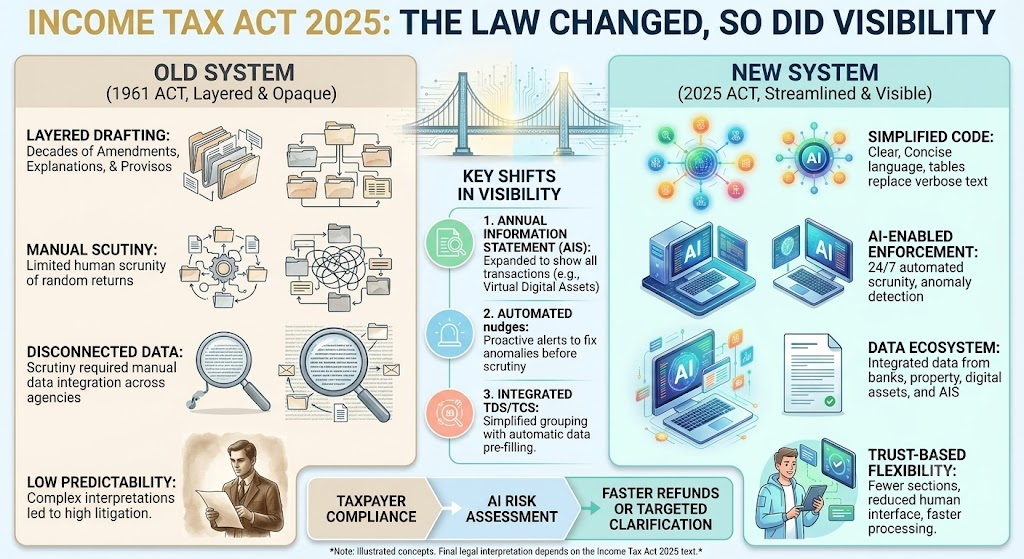
But here is what deserves attention: the Income Tax Act 2025 is not simply a rename. It is built for a compliance system that already knows more about your finances than most taxpayers realise. At Adwani and Company, we work with individuals and businesses every day who are only now discovering how deep this visibility goes – and how the Income Tax Act 2025 formalises it further.
What Is the Income Tax Act 2025?
The Income Tax Act 2025 received Presidential assent on 21st August 2025 and came into force on 1st April 2026, repealing the Income Tax Act, 1961 in its entirety. According to the Income Tax Department’s official FAQs, the 1961 Act stood repealed from that date, though transitional provisions ensure pending assessments and appeals from earlier years continue smoothly under the old framework.
The Income Tax Act 2025 condenses 819 sections and 14 schedules from the old law into 536 sections and 16 schedules. It does not introduce a new tax burden – its stated purpose is to make the law more predictable, more readable, and easier to comply with, reducing dependence on expert interpretation for routine matters.
Income Tax Act 2025 vs Income Tax Act 1961: What Actually Changed
From “Previous Year” and “Assessment Year” to a Single “Tax Year”
One of the most visible shifts under the Income Tax Act 2025 is the replacement of the old dual-year system. Under the 1961 Act, income earned in a “Previous Year” was taxed in the following “Assessment Year” a structure that confused generations of taxpayers. The Income Tax Act 2025 collapses both into one concept: the Tax Year, a 12-month period running from 1st April to 31st March, applicable from Tax Year 2026-27 onward.
Fewer Sections, More Structure
TDS provisions that were once scattered from Section 192 to Section 194T under the old law are now consolidated primarily under Sections 392 and 393 of the Income Tax Act 2025. Deductions under familiar provisions such as Section 80C and 80D are retained in substance, simply renumbered and reorganised into clearer, tabular chapters.
Why the Income Tax Act 2025 Is Really About Visibility
My colleague’s question was not really about the law – it was about visibility. Whether the system sees him before he even speaks. It does, and the Income Tax Act 2025 is designed to make that visibility sharper, not weaker. Here is how it actually works in practice:
- Banks report specified high value transactions – large cash deposits, big fixed deposits, and high-value credit card spends – to the tax department.
- Mutual funds, registrars, and sub-registrars report your investments and property transactions, often before you file your return.
- TDS and TCS data from employers, banks, and buyers is matched automatically against your PAN.
- All of this consolidates into your Annual Information Statement (AIS) – a financial mirror of you that the department reviews before you do.
- Under the Income Tax Act 2025, this matching architecture, including the faceless assessment framework, now has direct statutory backing rather than resting on executive schemes.
At Adwani and Company, Dr. Haresh Adwani – a PhD holder in Commerce and a law graduate – frequently explains to clients that the Income Tax Act 2025 does not create this data-matching system; it simply gives the existing digital compliance framework a firmer legal foundation.
Understanding Your AIS Under the Income Tax Act 2025
Your Income Tax Return is not the only document telling the government about your finances. It is the summary. The real story is already being written, transaction by transaction, well before you sit down to file and under the Income Tax Act 2025, that story is checked with more automation than ever.
| Practical Example: Why AIS Mismatches Trigger Notices Suppose your salary employer reports TDS on income of ₹18 lakh for the year, your bank reports a fixed deposit interest credit of ₹1.5 lakh, and a mutual fund house reports redemption proceeds of ₹6 lakh. If your filed ITR shows total income of only ₹15 lakh, the mismatch between your AIS data and your return is flagged automatically. In the vast majority of such cases, the gap is not deliberate under-reporting – it is simply unawareness of what has already been reported against your PAN. |
This is precisely why, under the Income Tax Act 2025 compliance environment, checking your AIS before filing is no longer optional diligence it is a basic filing step.
What Individuals and Businesses Must Do Under the Income Tax Act 2025
- Download and review your AIS and Form 26AS before filing your return.
- Reconcile AIS entries against your bank statements, investment records, and books of account.
- Flag and correct any inaccurate third-party reporting through the feedback mechanism on the AIS portal.
- Maintain consistent figures across your ITR, GST returns (where applicable), and MCA filings, since the Income Tax Act 2025 framework increasingly cross-references these sources.
- Retain supporting documentation for high-value transactions, since these are the entries most likely to be scrutinised under the Income Tax Act 2025.
Read our detailed guide on AIS and Form 26AS Reconciliation for a step-by-step reconciliation checklist.
Common Mistakes That Invite Scrutiny Under the Income Tax Act 2025
- Filing returns without checking AIS or Form 26AS first.
- Ignoring small mismatches, assuming they are too minor to matter.
- Reporting income figures inconsistent with TDS/TCS already matched to your PAN.
- Treating the transition to the Income Tax Act 2025 as a reason to delay routine compliance.
- Responding to a mismatch notice without professional review of the underlying AIS entries.
How Adwani and Company Helps You Navigate the Income Tax Act 2025
Interpreting a newly re-codified statute alongside decades of case law built under the old Act requires both technical and legal grounding. Dr. Haresh Adwani, who holds a PhD in Commerce and a law degree, brings exactly that combination to the firm’s advisory work, helping clients read the Income Tax Act 2025 in light of its practical, day-to-day compliance implications rather than just its renumbered sections.
At Adwani and Company, businesses and individuals receive support with:
- AIS and Form 26AS reconciliation before filing
- Income Tax Act 2025 transition advisory for businesses and professionals
- ITR filing and representation before tax authorities
- Response drafting for income tax mismatch notices
- Ongoing compliance reviews aligned with the Income Tax Act 2025
Learn more about our Income Tax Return Filing Services to stay ahead of the compliance curve.
1. What is the Income Tax Act 2025 and when does it apply?
The Income Tax Act 2025 is India’s new direct tax law that replaced the Income Tax Act, 1961 with effect from 1st April 2026. It applies to income earned from Tax Year 2026-27 onward, while income earned up to 31st March 2026 continues to be governed by the 1961 Act.
2. Does the Income Tax Act 2025 increase my tax liability?
No. The Income Tax Act 2025 is primarily a simplification and re-codification exercise. It reorganises sections, introduces the single “Tax Year” concept, and streamlines TDS provisions, but it does not itself impose new taxes or change existing slab rates.
3. What is the Annual Information Statement (AIS) and why does it matter under the Income Tax Act 2025?
The AIS is a consolidated statement showing the financial transactions reported to the Income Tax Department by banks, mutual funds, registrars, and employers. Under the Income Tax Act 2025, this reporting and matching framework continues, and often intensifies, making AIS reconciliation essential before filing your return.
4. What is the “Tax Year” under the Income Tax Act 2025?
Tax Year is a single 12-month period from 1st April to 31st March that replaces the earlier dual concept of “Previous Year” and “Assessment Year” used under the Income Tax Act, 1961.
5. Will pending income tax notices or assessments be affected by the Income Tax Act 2025?
No. Pending proceedings, assessments, and appeals relating to periods before 1st April 2026 continue to be governed by the Income Tax Act, 1961 under the transitional provisions.
6. How can I avoid receiving a notice under the Income Tax Act 2025 framework?
The most common cause of notices is a mismatch between your ITR and your AIS, not deliberate under-reporting. Reviewing your AIS, reconciling it against your books, and filing accurately are the most effective safeguards.
Conclusion: The Law Has Changed, the Visibility Has Not Gone Anywhere
The Income Tax Act 2025 has changed the law’s structure, language, and section numbers. What it has not changed is the underlying reality: the tax department sees your financial footprint before you file, and under the Income Tax Act 2025, that visibility is, if anything, sharper. Mismatches remain the leading cause of notices – not deliberate under-reporting, but unawareness.
Check your AIS. Match it against what you are about to file. And if you want expert guidance from professionals like Dr. Haresh Adwani on how the Income Tax Act 2025 applies to your specific situation, connect with Adwani and Company today.
About Author: Archana Dahibhate
Archana Dahibhate is a finance professional at Adwani & Co LLP, specializing in taxation, accounting, and regulatory compliance. She is passionate about simplifying complex tax and business concepts into practical insights that help businesses and individuals make informed decisions. Through her articles, she shares reliable, up-to-date guidance on taxation, GST, and financial compliance.
Disclaimer
This article is intended for general informational and educational purposes only and does not constitute legal, financial, or professional tax advice. While every effort has been made to ensure accuracy based on publicly available information from the Income Tax Department as of the date of publication, tax laws and their interpretation are subject to change. Readers should consult a qualified chartered accountant or tax professional, such as the team at Adwani and Company, before making any decisions based on this content.