
“In taxation, the professional who stops learning today becomes the professional who gives wrong advice tomorrow.”
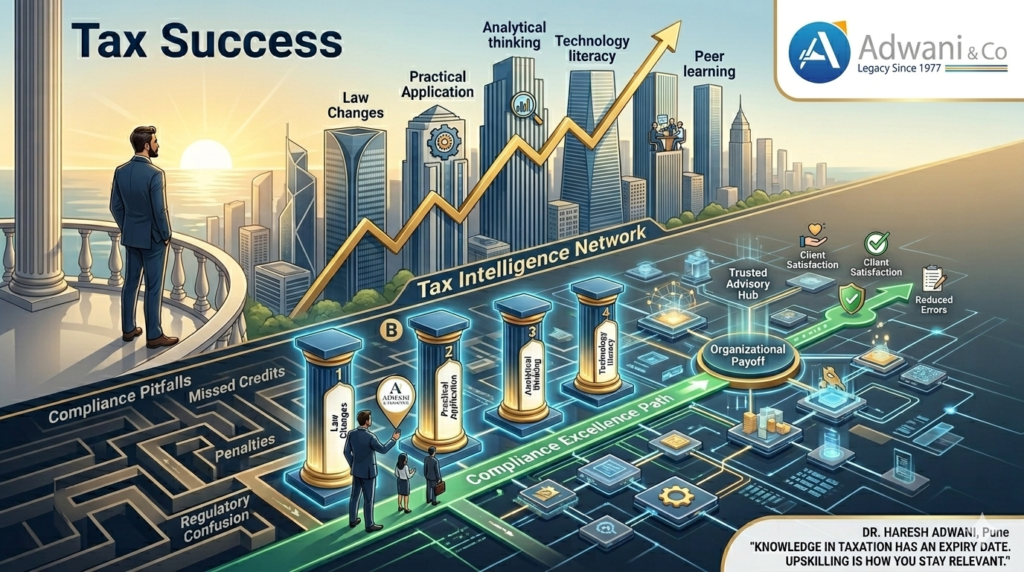
Upskilling in taxation is not a one-time checkbox for CA professionals it is a non-negotiable, continuous discipline. If you work in taxation as a Chartered Accountant, tax consultant, HR professional, or finance manager, you already know that GST rates change, Income Tax provisions get amended, and new CBDT circulars arrive on a Monday morning with immediate effect. The professional who relies solely on knowledge from their CA exams or a seminar three years ago is operating with an outdated map in a city that has been rebuilt.
This is the philosophy at the core of Adwani and Company, one of India’s trusted CA firms, where Dr. Hareh Adwani has championed continuous taxation learning for over a decade. As Dr. Adwani often says: “Knowledge in taxation has an expiry date. Upskilling is how you stay relevant.”
Why Upskilling in Taxation Is No Longer Optional
India’s tax landscape is among the most dynamic in the world. Since the landmark GST rollout in 2017, there have been hundreds of notifications, circulars, and amendments. The Income Tax Department regularly revises filing norms, introduces new forms, and updates compliance timelines. The GST Portal itself undergoes technical and regulatory overhauls that directly impact how professionals file returns and respond to notices. Upskilling in taxation bridges the gap between what you once knew and what is currently applicable and in today’s environment, that gap widens faster than ever.
Also Read:
https://www.adwaniandco.com/blog/nri-tax-rules-10-critical-questions-before-returning-to-india
The 5 Pillars of Upskilling in Taxation
At Adwani and Company, Dr. Hareh Adwani has identified five core areas where upskilling in taxation must be focused and structured not ad hoc or reactive.
1. Staying current with law changes
Regular tracking of amendments in GST, Income Tax Act, Customs, and allied tax laws is the foundation of any serious taxation upskilling effort. This means reading CBDT and CBIC notifications as they are issued, understanding their practical impact, and updating internal processes accordingly. The Ministry of Corporate Affairs (MCA) also periodically revises compliance norms, making cross-law awareness essential.
2. Understanding practical application in taxation upskilling
Law reading alone is insufficient. A professional truly excels at continuous taxation learning when they can interpret how a new provision translates to real client situations whether it’s a manufacturing firm’s input tax credit reversal or a startup’s TDS obligations on ESOP payouts. Bridging theory and application is where competent upskilling in taxation delivers the most value.
3. Building analytical and advisory thinking
The shift from pure compliance to advisory is where upskilling in taxation truly delivers business value. As Dr. Hareh Adwani puts it: “Clients don’t just need someone to file returns they need a trusted advisor who can see around corners.” Analytical thinking, nurtured through case studies and scenario planning, is the vehicle for that shift.
4. Leveraging technology in taxation upskilling
AI-enabled reconciliation tools, automated notice management systems, and real-time GST data analytics are now mainstream. A professional committed to upskilling in taxation must be comfortable not just with the law, but with the technology platforms that implement it. Digital fluency is now inseparable from tax competency.
5. Learning from experience and peers
Internal case discussions, cross-team knowledge sharing, and peer review of complex tax positions are underrated but powerful upskilling mechanisms. At Adwani and Company, structured internal sessions where team members present recent cases have become a cornerstone of the firm’s ongoing taxation learning culture.
What Continuous Upskilling in Taxation Really Looks Like
There is a common misconception that continuous learning in taxation means attending webinars or subscribing to a newsletter. In practice, a genuine upskilling framework at the organizational level includes weekly law update briefings (20-minute internal sessions covering new notifications and tribunal decisions), monthly deep-dives into one complex topic through case studies, quarterly external training via ICAI or CPE providers, annual skill assessments to identify knowledge gaps, and technology training cycles whenever new portal features or automation tools are adopted. This structure is not theoretical Adwani and Company has implemented it precisely this way, with measurable results in client satisfaction, reduced compliance errors, and team retention.
Elements of a Strong Taxation Learning Framework
- Weekly law update briefings 20-minute internal sessions covering new notifications, circulars, and tribunal decisions.
- Monthly deep-dives One complex topic per month, explored through case studies and hypotheticals (e.g., “How do the new ITC reversal rules affect mixed supply businesses?”).
- Quarterly external training Structured programs from ICAI, industry bodies, or recognized CPE providers.
- Annual skill assessments Self-assessments or peer reviews to identify knowledge gaps and guide individual development plans.
- Technology training cycles Hands-on sessions whenever new portal features, compliance software updates, or automation tools are adopted.
This is not theoretical. Adwani and Company has implemented precisely this structure, and the results in terms of client satisfaction, reduced compliance errors, and team retention have been measurable and significant.
The HR Role in Building a Taxation Upskilling Culture
Upskilling in taxation cannot happen in a vacuum it requires deliberate organizational design. HR plays a decisive role in designing regular technical training calendars aligned with the tax compliance cycle, creating platforms for knowledge sharing, encouraging cross-functional dialogue between tax and advisory teams, and supporting employees during peak-pressure periods like March year-end or GST annual return season. Most importantly, HR must promote a culture where asking questions is celebrated as intellectual curiosity, not penalized as ignorance. As Dr. Hareh Adwani has noted: “When people feel safe asking questions, the quality of work improves. Fear of looking uninformed is the enemy of upskilling.”
HR Actions That Drive Taxation Upskilling
- Designing regular technical training calendars aligned with the tax compliance cycle.
- Creating platforms for knowledge sharing from internal wikis to structured debrief meetings.
- Encouraging cross-functional dialogue between tax, audit, and advisory teams.
- Supporting employees during peak-pressure periods (March year-end, GST annual return season) with guidance rather than adding workload.
- Promoting a culture where asking questions is celebrated as intellectual curiosity, not penalized as ignorance.
- As Dr. Hareh Adwani has noted in firm-wide communications: “When people feel safe asking questions, the quality of the work improves. Fear of looking uninformed is the enemy of upskilling.” This mindset, embedded in the culture of Adwani and Company, is what separates high-performing tax firms from average ones.
·
Real-World Cost of Not Upskilling in Taxation
Consider a mid-sized manufacturing company whose internal tax team was unaware of the October 2023 CBIC circular clarifying the reversal of ITC on capital goods proportionately used for exempt supplies. The team filed GST returns without making the required reversal. When a GST audit was triggered, the company faced a demand of ₹18.4 lakh including interest and penalty for FY 2022-23 alone. Had their team participated in even one structured upskilling in taxation session covering that circular, the error would have been caught before filing. The cost of that single knowledge gap exceeded what a full year’s professional development program would have cost.
How Technology Is Reshaping Upskilling in Taxation
Upskilling in taxation today is inseparable from technology literacy. The GST Portal’s GSTR-2B reconciliation mechanism, the new Annual Information Statement (AIS) on the Income Tax portal, and MCA’s V3 portal all require tax professionals to be digitally fluent not just legally aware. Online learning platforms, micro-certification courses, and ICAI’s e-learning modules have made continuous taxation learning more accessible than ever. The barrier to upskilling is no longer access to content it is the discipline to prioritize it consistently.
Government Sources Essential for Upskilling in Taxation
Key Official Sources to Follow
- Income Tax Department Circulars, press releases, new ITR forms, and CBDT orders are published here first. Bookmarking this is non-negotiable.
- GST Portal: Notifications, clarifications, and portal update advisories. The GSTN regularly publishes user advisories that contain critical compliance intelligence.
- MCA Portal : For professionals advising companies, MCA’s circulars on company law, LLP regulations, and compliance deadlines are essential reading.
- ITAT and High Court judgments: Case law shapes how provisions are interpreted in practice. Tracking key judicial decisions is a hallmark of an upskilled taxation professional.
- At Adwani and Company, the team maintains curated trackers of government portal updates, ensuring that no significant change goes unnoticed or unaddressed in client work.
The Organizational Payoff of Investing in Taxation Upskilling
- The firms that invest seriously in upskilling in taxation do not just build more knowledgeable teams. They build competitive advantages that compound over time. They deliver fewer errors. Their professionals give more confident, proactive advice. Their clients stay longer, trust deeper, and refer more. Their teams experience lower burnout because competence breeds confidence, and confidence reduces anxiety in high-pressure situations.
- This is what Dr. Hareh Adwani has built at Adwani and Company not a firm that waits for the next regulation to react, but one that anticipates change, upskills proactively, and delivers accordingly. Continuous taxation learning is not a cost on the P&L of a professional firm. It is the investment that protects and grows every other line on it.
Conclusion: Upskilling in Taxation Is a Professional Commitment
The professionals and firms that thrive in India’s evolving tax environment are not those with the most degrees or the longest experience they are those with the discipline to keep learning. Upskilling in taxation is not a seminar you attend once a year. It is a structured, conscious, and continuous commitment to staying current, thinking analytically, and serving clients with the highest standard of accuracy and insight.
Dr. Hareh Adwani and the team at Adwani and Company have made this commitment the foundation of the firm’s identity. Success, as they demonstrate every day, does not come from what you already know. It comes from your willingness to keep learning consistently, consciously, and continuously.
Frequently Asked Questions on Upskilling in Taxation
1. What does upskilling in taxation mean for CA professionals?
For CA professionals, upskilling in taxation means continuously updating knowledge of GST, Income Tax, and allied laws through structured training, practical case study reviews, technology literacy, and analytical skill development not just occasional seminar attendance.
2. How often should a tax professional upskill?
Given the frequency of amendments and notifications in India’s tax system, meaningful upskilling in taxation should happen monthly at a minimum with weekly awareness updates for active practitioners managing client compliance.
3. What are the best sources for taxation continuous learning in India?
The Income Tax Department portal, GST Portal, MCA website, ICAI e-learning modules, and curated legal databases like TaxSutra or TaxMann are the most reliable sources for authoritative taxation upskilling content.
4. How can a CA firm build a taxation upskilling culture?
By designing structured internal training programs, encouraging knowledge-sharing sessions, tracking government notifications systematically, and creating a safe environment where team members can ask questions and learn from complex client cases as practiced at Adwani and Company.
5. What is the role of HR in supporting upskilling in taxation?
HR professionals in CA firms play a critical role in designing training calendars, enabling cross-functional learning platforms, providing support during peak compliance seasons, and building a culture where continuous taxation learning is valued and rewarded.
6. Does upskilling in taxation include technology training?
Absolutely. Modern taxation upskilling must include proficiency in the GST Portal, Income Tax AIS/TIS, MCA V3, and practice management and automation tools. Technology literacy is now inseparable from tax competency.
7. What happens if a tax professional does not upskill regularly?
Outdated tax knowledge leads to compliance errors, missed credits or deductions, incorrect advice, penalty exposure for clients, and erosion of professional credibility. As illustrated in our example, a single knowledge gap can cost multiples of what an upskilling program would have required.
About the Author
Nidhi Adwani is the Human Resources Manager at Adwani & Co. She is a Law Graduate and holds an MBA in Human Resources. She manages recruitment, employee engagement, team development, workplace culture, and the firm’s social media and content activities. Passionate about people and organizational growth, she also contributes articles for ITRAdvisor and Adwani & Co. Her writing focuses on HR practices, leadership, workplace engagement, and professional development, offering practical insights for professionals and businesses.
Legal Disclaimer: This article is published for informational and educational purposes only. Nothing contained herein constitutes legal, financial, or tax advice, nor should it be treated as a substitute for professional consultation tailored to your specific circumstances. Tax laws, rates, and provisions are subject to change; readers are strongly advised to consult a qualified Chartered Accountant or tax advisor before acting on any information in this article.
All content is original. References to government portals and statutory provisions are paraphrased for educational purposes in compliance with fair use principles. No content has been reproduced from third-party sources