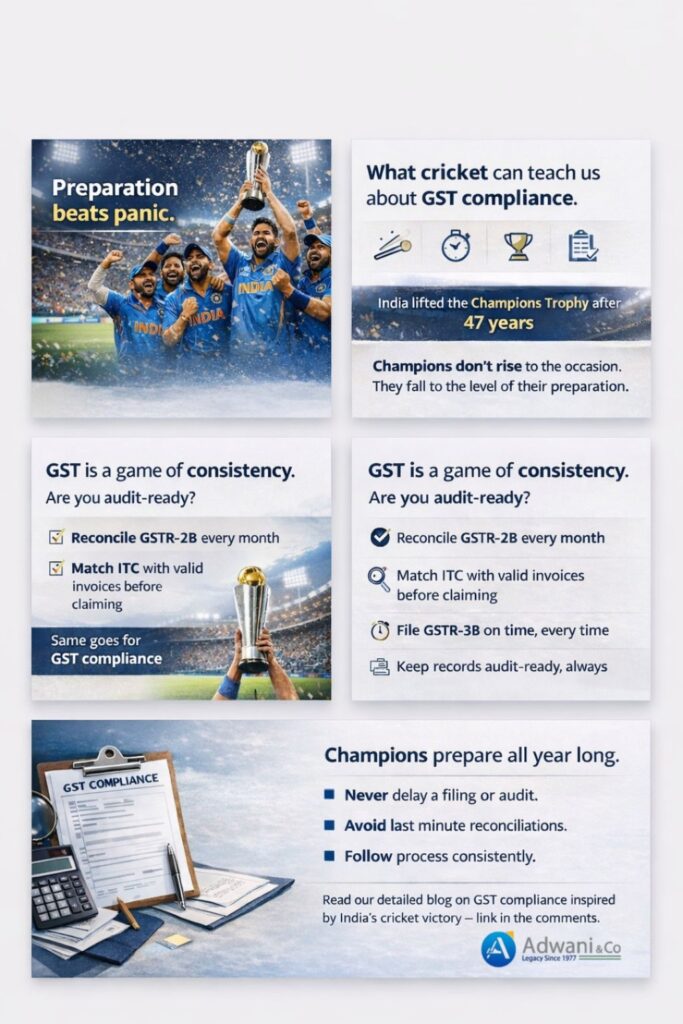
India lifted the Champions Trophy. Millions celebrated. But beyond the stadium roar, there is a lesson every CFO and business owner should carry back to their boardroom.
Cricket at the highest level is not won by talent alone. It is won by consistency, preparation, and an unwavering discipline to follow the process — even when no one is watching. Sound familiar? It should. Because that is exactly what GST compliance demands of your business.
At Adwani & Co LLP — a practice built on structured taxation and compliance discipline since 1977 — we have seen this truth play out across hundreds of businesses over five decades.
The Match was Won Before It Began
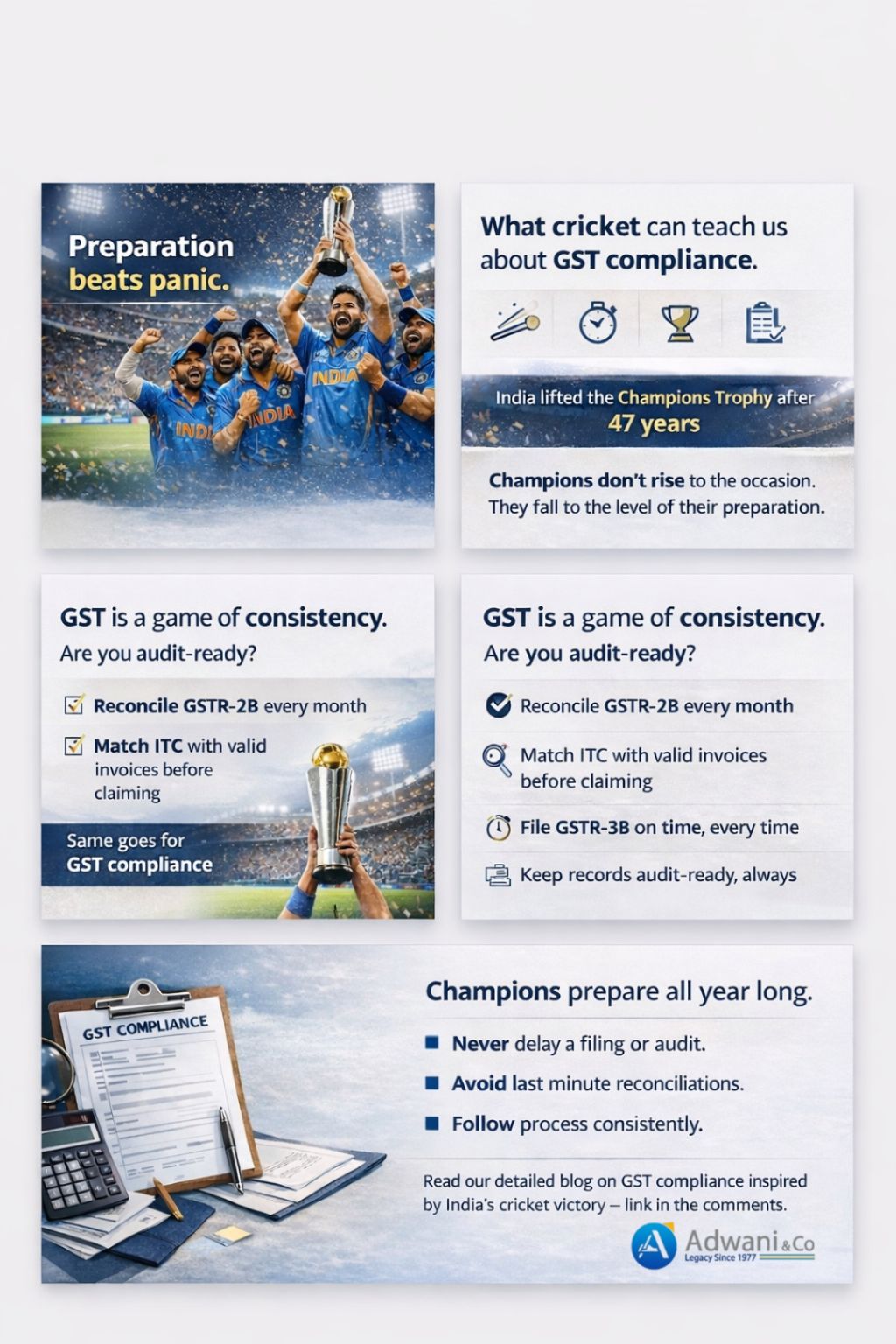
Champions do not rise to the occasion. They fall to the level of their preparation.
India’s victory was months in the making. Strategists studied opponents. Players trained their specific roles. The team built systems that could perform under pressure.
Your GST compliance works the same way. The business that sails through a GST audit did not get lucky — they prepared. They reconciled every month. They tracked every invoice. They built a system. The business that receives a GST notice and scrambles? They waited for match day to prepare.
Lesson 1: Consistency Over Brilliance
India did not win the Champions Trophy with one brilliant innings. They won it through consistent performance across every match.
The biggest myth in GST compliance is that one big year-end exercise is enough. It is not.
What actually protects your business:
- Reconciling GSTR-2B with your books every single month — not once a year
- Matching your outward supplies in GSTR-1 with your actual sales register monthly
- Ensuring vendor invoices are uploaded before you claim Input Tax Credit
- Filing GSTR-3B on time, every time — because late fees compound quickly
One missed month creates a cascading problem. Consistent compliance creates a clean audit trail.
Lesson 2: Know the Rules of the Game
Every Indian cricketer knows the Duckworth-Lewis-Stern method, the power play restrictions, and the no-ball rules. Ignorance of the rules in cricket — and in GST — is never a defence.
Here are the rules many business owners do not know until it is too late:
- Input Tax Credit on blocked categories (Section 17(5)) cannot be claimed — even if your vendor charges GST on food, personal vehicle use, or club memberships
- Reverse Charge Mechanism (RCM) applies when you purchase from unregistered vendors, use freight services, or subscribe to foreign SaaS platforms — you pay GST directly to the government
- E-invoicing is mandatory above certain turnover thresholds — failure to comply invalidates your ITC claims in the buyer’s hands
- Place of supply rules for services determine whether you pay IGST or CGST/SGST — getting this wrong triggers mismatches and notices
Knowledge of these rules is not optional. It is the foundation of every GST strategy we build for our clients.
Lesson 3: Your Team’s Roles Must Be Clear
India’s Champions Trophy squad succeeded because every player knew their role. Rohit Sharma’s job was different from Jasprit Bumrah’s. Both were essential.
In your finance and compliance function, role clarity is equally critical:
- Who is responsible for collecting vendor invoices before the 2B cut-off?
- Who reconciles GSTR-1 vs the sales ledger each month?
- Who reviews RCM applicability when a new vendor is onboarded?
- Who tracks upcoming GST amendments and circulars?
If the answer to any of the above is ‘I am not sure’, that is a gap in your compliance team’s fielding. And gaps get exploited — by the tax department, not a cricket opponent.
Lesson 4: Records Are Your Replay Technology
Modern cricket uses DRS — Decision Review System — where every delivery is recorded and can be reviewed in slow motion. Technology creates accountability.
In GST, your records are your DRS. The tax department can scrutinise your returns for up to three years from the due date of the annual return.
What must be maintained:
- All tax invoices, debit notes, and credit notes — both issued and received
- GSTR-1, GSTR-3B, and GSTR-2B for every return period
- E-way bills and e-invoices for all applicable transactions
- Reconciliation statements prepared at the time of filing — not reconstructed later
- HSN-wise sales summaries for GSTR-9 annual return
FY 2022-23 records must be maintained until at least December 2026. Most businesses do not realise this until they receive a notice asking for documentation from three years ago.
Lesson 5: Get Expert Coaching
No international cricket team competes without specialist coaches — batting coaches, bowling coaches, fielding coaches, and strategic analysts.
Yet many businesses with turnovers of ₹10 crore and above try to manage GST compliance through a general accountant or internal bookkeeper without specialist indirect tax oversight.
The cost of non-compliance is not just the penalty. It is the management time lost, the reputational risk of a GST audit, the disruption to vendor relationships when ITC mismatches are discovered, and the interest on late payments that accrues silently. Specialist advisory is not an expense. It is the fielding coach who prevents the boundary.
The Adwani & Co LLP Approach
Since 1977, we have built our practice on one belief: that compliance is not a burden — it is a competitive advantage.
Businesses that maintain clean GST records:
- Access working capital faster through timely ITC refunds
- Build credibility with lenders, investors, and large enterprise clients
- Avoid the disruption and cost of GST audits and scrutiny proceedings
- Are acquisition-ready and due-diligence ready at any point
Our Indirect Taxation practice, led by Prafullata Khandagale, delivers structured GST compliance, ITC optimisation, RCM advisory, and GSTR-9 filing support to businesses across sectors.
Your Next Step
India’s victory was celebrated for one evening. The preparation for the next tournament began the very next morning.
Your GST compliance works the same way. The best time to build a structured process was at the start of the financial year. The second best time is today.