
Tax Notice Panic: The Costly Mistake to Avoid
A tax notice arrived. But the biggest mistake didn’t happen when the department sent it it happened the moment it was opened.
A business owner reads the words “Income Tax Department” or “GST authority” on an envelope, and the very first thought is rarely factual. It’s emotional: “We’ve done something wrong.” The worry begins before anyone has actually read what the notice says or understood the matter it relates to.
Having handled scrutiny assessments and tax litigation matters for over two decades, I have watched this reaction play out again and again. A tax notice arrives, and the first response is almost always fear thoughts jump straight to penalties, disputes, and worst-case consequences. But a tax notice is not a verdict. It is a communication from the department seeking information, clarification, or verification about a specific matter.
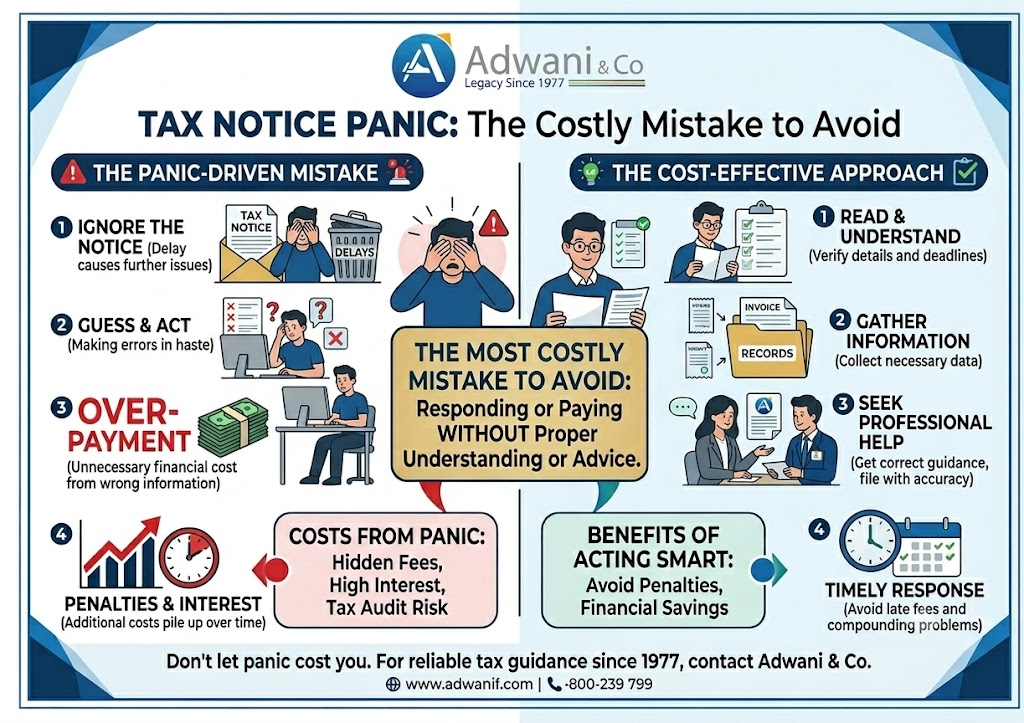
Why a Tax Notice Feels Like a Verdict and Why It Isn’t
In most cases, the real issue behind a tax notice has nothing to do with intentional wrongdoing. It is usually one of the following:
- A missing or delayed document
- A delayed response to an earlier communication
- A genuine difference in interpretation of a provision
- A transaction that simply needs a fuller explanation
The biggest mistake businesses and individuals make is treating a tax notice as a problem to fear before they have even understood the reason behind it. That single reflex panic before analysis is what turns a routine compliance query into weeks of unnecessary stress.
What a Tax Notice Actually Means Under Indian Tax Law
Both the Income Tax Department and the GST Portal now rely heavily on automated data matching AIS entries, GSTR filings, e-way bills, TDS records, and MCA filings are cross-checked continuously. A tax notice is frequently the system’s way of flagging a mismatch, not an accusation of fraud. Understanding this distinction is the first step in responding to any tax notice correctly.
Key principle A tax notice is a request for information, not a finding of guilt. How you respond to a tax notice determines the outcome far more than the notice itself.
A Practical Example: How a Simple Mismatch Becomes a Tax Notice
Consider a mid-sized trading firm that reports an annual turnover of ₹1.6 crore in its income tax return. The same year, its GSTR-3B filings show cumulative sales of ₹1.85 crore, and MCA-filed financial statements reflect ₹1.9 crore. None of these figures involve any actual tax evasion the gap arises from timing differences in revenue recognition and a few credit notes that were not reconciled.
However, once this ₹30 lakh inconsistency is flagged across three separate government systems, a scrutiny-style tax notice is generated automatically. If the business panics and responds emotionally or worse, ignores the notice the matter can escalate into a formal assessment. If the business instead gathers reconciliation statements, credit note records, and GST returns, the same tax notice is typically closed within one clarification cycle.
How to Respond to a Tax Notice the Right Way
Tax matters are not solved through panic. They are solved through clarity and the right strategy. Every well-handled tax notice response follows the same disciplined sequence:
Step 1: Understand What Is Being Asked
Read the tax notice line by line. Identify the specific section under which it has been issued, the exact query being raised, and the response deadline.
Step 2: Review the Facts
Go back to the underlying transaction, return, or disclosure the tax notice refers to, before forming any conclusion about what went wrong.
Step 3: Check the Supporting Documents
Gather invoices, bank statements, reconciliation records, and prior correspondence relevant to the tax notice.
Step 4: Analyse the Applicable Provisions
Determine which provisions of the Income-tax Act or GST law actually govern the matter raised in the tax notice, rather than assuming the worst.
Step 5: Decide the Right Response
Draft a factual, well-documented reply. A rushed or emotional response to a tax notice often creates more complications than the original query.
Why Delay Turns a Manageable Tax Notice Into a Bigger Problem
Over the years, I have consistently seen that tax issues become complicated not because of the original matter, but because of delayed action and incorrect assumptions. A tax notice that is ignored, or answered in haste without proper reconciliation, tends to escalate additional queries, extended timelines, and in some cases, formal assessment proceedings follow. A tax notice is not the end of the road. It is a situation that needs careful evaluation, not an emergency that needs an instant, unplanned reaction.
The Role of Professional Guidance in a Tax Notice Matter
GST and income tax law combine taxation, accounting, and legal interpretation which is why businesses increasingly prefer multidisciplinary guidance when a tax notice arrives. Dr. Haresh Adwani, PhD in Commerce and a qualified law graduate, brings both financial and legal grounding to how a tax notice is analysed and answered. At Adwani and Company, this combination of tax expertise and legal precision has helped hundreds of businesses across Pune and Maharashtra convert an alarming tax notice into a routine, well-documented clarification.
As Dr. Haresh Adwani often tells clients during scrutiny and litigation engagements, the biggest risk is rarely the tax notice itself it is the panic-driven decision made in the first 24 hours after it arrives.
Learn more about our Taxation & Compliance Services.
Read our detailed guide on GST Notice 2026: What Businesses Miss for a closer look at GST-specific notice triggers.
Government Signals Every Taxpayer Should Watch
According to compliance advisories referenced on the Income Tax Department portal and the Ministry of Corporate Affairs website, cross-verification between ITR filings, GST returns, and company filings continues to expand. This means a tax notice today is far more likely to be data-driven than discretionary another reason panic is the wrong first response and reconciliation is the right one.
How Businesses Can Reduce Tax Notice Risk
- File GST and income tax returns on time, every time
- Reconcile ITR figures against AIS, Form 26AS, and GST data quarterly
- Keep invoices, contracts, and bank records organised and easily retrievable
- Avoid last-minute or unverified deduction claims
- Involve a qualified tax professional the moment a tax notice arrives, not after a deadline is missed
Conclusion: Treat a Tax Notice as a Question, Not a Verdict
A tax notice, whether under income tax or GST law, is fundamentally a request for information. Businesses that meet it with clarity, documentation, and timely action almost always resolve the matter without lasting consequences. Businesses that meet it with panic frequently turn a simple clarification into a prolonged, stressful dispute.
If you or your business has received a tax notice and you want expert guidance before responding, connect with Adwani and Company today. Dr. Haresh Adwani and the team at Adwani and Company help clients turn an alarming tax notice into a calmly managed, well-documented resolution.
1.Is a tax notice always a sign of wrongdoing?
No. Most tax notices, whether from the Income Tax Department or GST authorities, are requests for clarification, verification, or missing documentation, not accusations of fraud.
2.What should I do first after receiving a tax notice?
Read the tax notice carefully, verify its authenticity on the official portal, note the response deadline, and gather the documents relevant to the matter before drafting any reply.
3.Can ignoring a tax notice make things worse?
Yes. An unanswered tax notice can allow the department to proceed on its own assessment of the matter, which typically results in a less favourable outcome than a timely, documented response.
4.How long do I have to respond to a tax notice?
Response timelines vary by notice type and section, but most tax notice deadlines fall between 15 and 30 days. The notice itself specifies the exact date.
5.Should I respond to a tax notice without professional help?
For routine clarifications it may be possible, but scrutiny, reassessment, or litigation-related tax notices should be reviewed by a qualified CA or tax professional before any reply is filed.
6.Does a tax notice always lead to a penalty?
No. Most tax notices are resolved through a clear explanation and supporting documents. Penalties typically arise only when a notice is ignored, mishandled, or when a genuine discrepancy remains unexplained.
.
About the Author
Dr. Haresh Adwani
Ph.D. in Commerce | Law Graduate | Managing Partner, Adwani & Co LLP Dr. Haresh Adwani holds a Ph.D. in Commerce and is a qualified Law graduate with over two decades of hands-on experience in GST advisory, direct taxation, and statutory compliance for businesses across Pune and Maharashtra. As Managing Partner of Adwani & Co LLP a firm established in 1977 by Advocate N. T. Adwani Dr. Adwani has guided hundreds of
SMEs, startups, and corporates through India’s evolving tax landscape. He is a recognised advisor on GST compliance, company formation, and Virtual CFO services, and regularly
contributes to professional seminars and industry forums in Pune.
Disclaimer: This article is intended for informational purposes only and does not constitute legal, tax, or professional advice. Every case involving income tax assessment proceedings depends on its own facts, and readers should consult a qualified tax professional before acting on any information contained here.