
Smart Salary Structuring
Here is something most salaried employees never realise: two colleagues earning the same ₹12 lakh CTC can take home very different amounts at the end of each month. The difference has nothing to do with performance, promotions, or side income. It comes down entirely to salary structuring for salaried employees in 2026 and most people are still unaware this lever even exists.
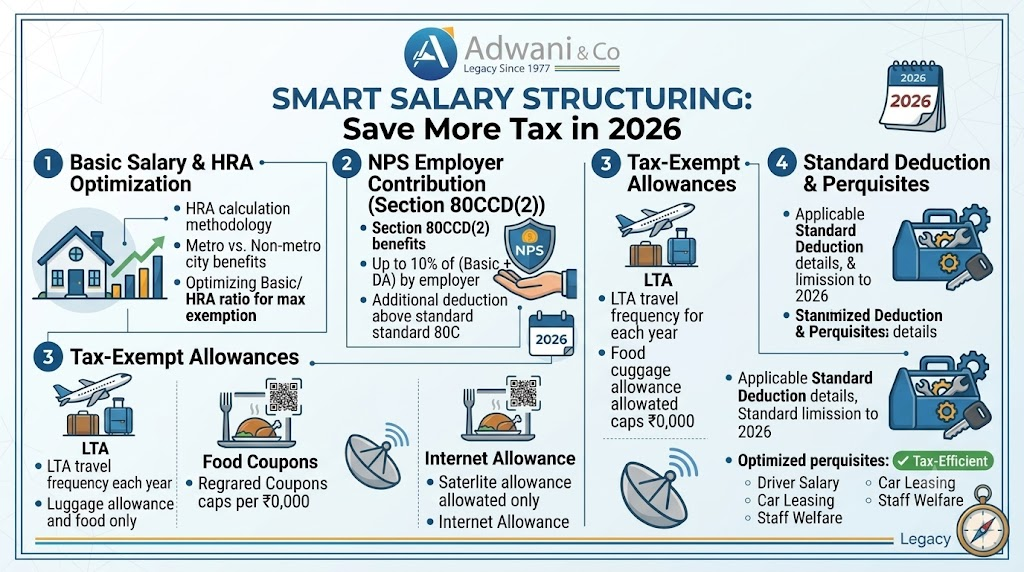
Effective 1 April 2026, the government has reinforced a fundamental shift in how it thinks about income tax for salaried employees 2026. The conversation is no longer just about saving tax through last-minute investments in February or March. It has moved upstream to how your salary is designed from Day One. If your compensation package has not been reviewed in the last twelve months, this article is worth reading carefully.
Why Salary Structuring for Salaried Employees Matters More in 2026
For years, the standard playbook for tax saving was predictable: invest in PPF, buy ELSS funds, pay insurance premiums before March 31, and submit proofs to HR. The new tax regime, however, has changed the rules of the game.
Under the new tax regime, most exemptions and deductions under Chapter VI-A including 80C, 80D, and HRA exemptions are not available. What remains, and what matters enormously, is how your salary is broken down into its components.
The 2026 reforms have introduced and reinforced several salary-level benefits that remain available even under the new regime:
- Tax-free meal allowance of up to ₹26,400 per year (₹50 per meal, two meals per working day)
- Standard deduction of ₹75,000 for salaried employees under the new tax regime
- Leave Travel Allowance (LTA) benefits for employees who opt appropriately
- NPS employer contribution deduction under Section 80CCD(2), available even under the new regime
- EPF and gratuity components that remain outside the taxable salary base
According to guidelines from the Income Tax Department (incometax.gov.in), the standard deduction under the new regime was increased to ₹75,000 in the Union Budget 2024-25, making tax-efficient salary design even more valuable for individuals earning in the ₹10–₹20 lakh range.
Expert Insight Dr. Haresh Adwani “Salary structuring is the most underutilised tool in personal tax planning today. Under the new tax regime, the components you choose to include in your CTC can legally save you ₹15,000 to ₹40,000 in annual taxes without a single additional investment.” Dr. Haresh Adwani, PhD (Commerce), Law Graduate, Senior Partner, Adwani and Company
The Real Salary Structuring Example: Same CTC, Different Take-Home
The best way to understand the power of salary restructuring India 2026 is through a practical, side-by-side comparison. Consider two salaried employees both earning ₹12 lakh per annum CTC, both opting for the new tax regime.
| Salary Component | Employee A (₹12 LPA CTC) | Employee B (₹12 LPA CTC) |
| Basic Salary | ₹7,20,000 | ₹4,80,000 |
| HRA | ₹2,40,000 | ₹1,80,000 |
| Meal Allowance (Tax-Free) | ₹0 | ₹26,400 |
| LTA | ₹0 | ₹60,000 |
| Special Allowance | ₹2,40,000 | ₹5,53,600 |
| Standard Deduction | ₹75,000 | ₹75,000 |
| Taxable Income (Approx.) | ₹11,25,000 | ₹9,68,600 |
| Estimated Tax Savings | — | ~₹20,000 – ₹25,000 more per year |
Employee B has the same CTC but earns approximately ₹20,000 to ₹25,000 more after tax every year simply because the salary was structured intelligently. Over five years, that is ₹1 lakh or more in additional take-home pay with zero additional investment or effort.
This is what take-home pay optimization looks like in practice. The meal allowance exemption alone ₹26,400 per year removes that amount from the taxable income base entirely.
Key Salary Structuring Components Available Under New Tax Regime 2026
Not all salary components receive equal tax treatment. Here are the most impactful ones for employees under the new tax regime:
1. Meal Allowance Exemption 2026
The meal allowance exemption 2026 allows employers to provide up to ₹50 per meal, twice per working day, on a tax-free basis. Assuming 22 working days per month, this translates to ₹2,200 per month or ₹26,400 annually that never enters the taxable income calculation. This is one of the cleanest, simplest, and most overlooked components in payroll tax planning India.
2. NPS Employer Contribution : Section 80CCD(2)
Even under the new tax regime, employer contributions to the National Pension System (NPS) up to 10% of basic salary are deductible under Section 80CCD(2). For an employee drawing ₹40,000 as basic, this means up to ₹48,000 per year in additional tax-free contribution. This is one of the most powerful components available to HR teams designing tax-efficient salary structures.
3. Standard Deduction for Salaried Employees
The standard deduction for salaried employees under the new tax regime stands at ₹75,000 per year. This is a flat, automatic deduction available to every salaried taxpayer no investment, no proof, no paperwork required. Understanding this deduction is fundamental to calculating your actual tax liability correctly.
4. Leave Travel Allowance (LTA)
LTA remains a permitted component for employees who opt out of the new tax regime. For those under the old regime, LTA claims for two domestic journeys in a four-year block can provide meaningful exemptions. HR teams designing compensation should include LTA thoughtfully based on employee preference.
How Salary Structuring for Salaried Employees Is Shifting Tax Planning
Dr. Haresh Adwani, with over four decades of experience in Indian taxation at Adwani and Company, Pune, observes that the philosophy of payroll tax planning India is undergoing its most significant change since the introduction of TDS compliance requirements.
Previously, the entire tax-saving conversation happened between January and March the investment declaration window. An employee would scramble to find eligible investments, submit proofs, and hope the numbers worked out. That model is increasingly outdated.
What is replacing it is April salary structuring a conversation that happens at the beginning of the financial year, between HR, payroll teams, and employees, to design compensation in a way that is tax-efficient from the very first payslip. As Dr. Haresh Adwani notes, this approach eliminates the February panic, improves cash flow through the year, and results in consistently higher take-home pay.
Read our detailed guide on Old vs New Tax Regime2025: Stop Guessing, Start Calculating
| Important Note for HR and Payroll Professionals Salary restructuring must comply with the Employment Contracts Act, Payment of Wages Act, and EPF & MP Act. Reducing basic salary disproportionately to inflate allowances can invite PF compliance issues. Always restructure under proper legal and CA guidance. |
Salary Structuring and New Tax Regime 2026: What You Must Review Now
If you are a salaried employee, here is a practical checklist to review with your HR or a qualified CA:
- Is your meal allowance component structured at the maximum permissible limit?
- Is your employer contributing to NPS on your behalf under Section 80CCD(2)?
- Has the ₹75,000 standard deduction been factored correctly into your TDS computation?
- Is your salary package aligned with the new tax regime slabs effective April 2026?
- Have you compared your post-tax take-home under both the old and new tax regimes for this year?
Adwani and Company, led by Dr. Haresh Adwani PhD in Commerce and law graduate with deep expertise in Indian taxation and employment law provides salary restructuring consultations for both employees and employers across Pune, Pimpri-Chinchwad, and beyond. Learn more about our Salary and Payroll Tax Planning services or read our detailed guide on New Tax Regime vs Old Tax Regime for Salaried Employees.
For official tax slab information and new regime rules, refer to the Income Tax Department incometax.gov.in. For EPF and wage-related compliance, refer to the EPFO portal epfindia.gov.in.
Q1. What is salary structuring for salaried employees and why does it matter in 2026?
Salary structuring refers to the process of dividing your total CTC into different components basic pay, allowances, and perquisites in a way that minimises taxable income legally. In 2026, with the new tax regime becoming the default option, structuring salary components like the meal allowance and NPS contribution correctly can save ₹15,000 to ₹40,000 or more annually.
Q2. Which salary components are tax-free under the new tax regime 2026?
Under the new tax regime 2026, key tax-efficient components include the meal allowance (up to ₹26,400 per year), NPS employer contribution under Section 80CCD(2), and the standard deduction of ₹75,000. Most other allowance exemptions, including HRA, are not available under the new regime.
Q3. Can my employer restructure my salary mid-year to save taxes?
Yes, many employers permit salary restructuring at the start of the financial year typically in April. Some also allow it mid-year under certain conditions. It is best to consult your HR department and a Chartered Accountant to understand what changes are permissible under your employment contract and applicable labour laws.
Q4. How does the meal allowance exemption 2026 work in practice?
The meal allowance exemption allows employers to pay up to ₹50 per meal for two meals per working day on a tax-free basis. For 22 working days per month, this equals ₹2,200 per month or ₹26,400 annually that is completely outside taxable income. The employer typically includes this as a separate component in the salary slip, often offset against meal vouchers or reimbursements.
Q5. Is take-home pay optimization the same as tax evasion?
Absolutely not. Salary structuring for salaried employees is a legal, government-sanctioned form of tax planning. The government has explicitly provided for certain allowances and deductions to encourage specific behaviours like retirement savings via NPS and employee welfare via meal allowances. Using these provisions correctly is tax planning, not tax evasion.
Q6. Should I consult a CA for salary restructuring or can I do it myself?
While a basic understanding helps, a qualified Chartered Accountant familiar with income tax for salaried employees 2026 can identify all legally available components, ensure compliance with PF and labour laws, and calculate the exact tax impact under both regimes. The savings usually far outweigh the advisory fee.
Conclusion: The New Frontier of Salary Structuring for Salaried Employees
The era of tax planning beginning in February is gradually giving way to April salary structuring — a more intelligent, proactive approach that builds tax efficiency into every payslip from the very first month of the financial year.
Two employees. Same CTC. Significantly different take-home pay. The only difference is how their salaries are designed. This is the real story of the new tax regime 2026 — and it is a story that every salaried professional, HR manager, and payroll team in India needs to understand right now.
As Dr. Haresh Adwani, PhD in Commerce and law graduate, and Senior Partner at Adwani and Company, consistently advises: the most powerful tax-saving tool available to salaried employees today is not a new investment product. It is a well-designed salary structure.
Ready to Restructure Your Salary and Save More Tax in 2026? Connect with Adwani and Company Pune’s trusted CA firm since 1977. Our team, led by Dr. Haresh Adwani, provides expert salary structuring consultations, payroll tax planning, and comprehensive income tax advisory for salaried employees and businesses across India. Book your consultation today at adwaniandco.com or call us to speak with a CA.
Author
CA Dipesh Gurubakshani is a Chartered Accountant with Adwani & Co LLP, Pune, specialising in income tax audit, direct taxation, and accounting advisory. He supports clients across statutory compliance, financial reporting, and income tax matters with a focus on accuracy, regulatory adherence, and disciplined execution.
DISCLAIMER
This article is published for informational and educational purposes only. It does not constitute financial, tax, legal, or professional advice. Tax laws and provisions are subject to change; readers are advised to consult a qualified Chartered Accountant or tax professional before making any financial or salary-related decisions. Adwani and Company shall not be liable for any action taken based solely on the information provided in this article.