
Role of HR in a CA Firm
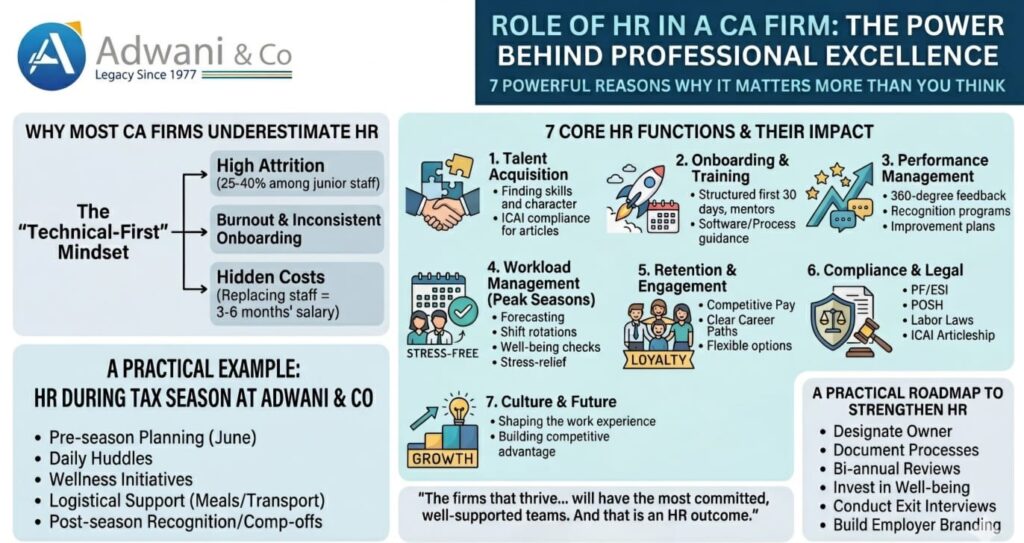
Role of HR in a CA Firm: The Invisible Force Behind Every Deadline Met and Every Client Served
There is a beautiful analogy that Nidhi Adwani recently shared: “HR in a CA firm is like salt in every dish. Not always visible during client meetings or filings… But the moment it is missing, everything feels off.”
Think about that for a moment.
When a client’s tax return is filed on time, they thank the CA. When an audit report is delivered without errors, the partner gets the credit. When a GST return is submitted before the deadline, the team celebrates. But behind every one of those moments, there is an invisible force that made it possible Human Resources.
The role of HR in a CA firm is perhaps the most underestimated function in the entire profession. In a world obsessed with numbers, compliance, and deadlines, it is easy to forget that behind every balance sheet is a human being someone who needs to be hired, trained, motivated, supported, and retained.
At Adwani and Company (https://www.adwaniandco.com/), we have long recognized that our greatest asset is not our technical expertise alone it is our people. And the function responsible for nurturing those people is HR. In this blog, we explore why the role of HR in a CA firm is the backbone of every successful practice and how it quietly shapes culture, performance, and growth.
Also read:
https://www.adwaniandco.com/blog/credit-card-income-tax-notice
Why Most CA Firms Underestimate the Role of HR
The “Technical-First” Mindset
Let us be honest. Most CA firms are built around technical excellence. The partners are Chartered Accountants. The managers are CAs. Even the article assistants are aspiring CAs. In such an environment, the natural tendency is to prioritize technical skills over people management.
HR is often treated as an administrative function someone who handles attendance, processes salaries, and posts job openings. This narrow view fundamentally undermines the role of HR in a CA firm and leads to problems that compound over time:
- High attrition, especially among article assistants and semi-qualified staff
- Burnout during peak seasons with no structured support system
- Inconsistent onboarding that leaves new hires confused and unproductive
- Cultural issues that go unaddressed until they become toxic
The firms that recognize HR as a strategic partner not just a support function are the ones that consistently outperform their peers.
The Numbers Behind the Problem
According to industry surveys, CA firms in India experience annual attrition rates of 25-40% among junior staff. The cost of replacing a trained team member factoring in recruitment, onboarding, training, and lost productivity can be 3 to 6 months of that person’s salary.
Now multiply that across a firm with 30-50 employees, and you will realize that poor HR practices are not just a “soft” problem they are a direct hit to the firm’s profitability.
The Core Functions of HR That Define the Role of HR in a CA Firm
1. Recruitment and Talent Acquisition
The role of HR in a CA firm begins with finding the right people. And in the accounting profession, “right” does not just mean technically qualified. It means finding individuals who can handle pressure, work collaboratively, communicate with clients, and grow within the firm’s culture.
Effective HR departments in CA firms:
- Build relationships with commerce colleges and CA coaching institutes for pipeline hiring
- Create structured interview processes that assess both technical and soft skills
- Develop employer branding that attracts top talent (yes, even CA firms need employer branding)
- Manage articleship registrations and ICAI compliance for article assistants
At Adwani and Company, our recruitment process is designed to identify not just skill but character. Dr. Haresh Adwani often says, “We can teach tax law. We cannot teach integrity and work ethic. HR helps us find people who already have both.”
2. Onboarding and Training
The first 30 days of a new hire’s experience determine whether they will stay for three years or leave in three months. HR ensures that new team members:
- Understand the firm’s culture, values, and expectations from day one
- Receive structured training on the firm’s software, processes, and client protocols
- Are paired with mentors who guide them through the initial learning curve
- Have clarity on their career path and growth opportunities within the firm
For article assistants, this is particularly critical. These young professionals are often experiencing their first workplace, and the quality of their onboarding shapes their entire perception of the CA profession.
3. Performance Management and Feedback
In the absence of structured performance management, CA firms tend to operate on an informal system: if no one complains, you are doing fine. This approach is deeply flawed because it provides no mechanism for growth, recognition, or early course correction.
A robust HR function implements:
- Quarterly performance reviews tied to specific, measurable goals
- 360-degree feedback that includes input from peers, seniors, and clients
- Recognition programs that celebrate outstanding work (not just during annual events)
- Performance improvement plans for team members who are struggling, before resorting to termination
4. Workload Management During Peak Seasons
This is where the role of HR in a CA firm becomes absolutely critical. Tax season particularly July through October and then again during January through March is brutal. 12-16 hour workdays, weekend work, constant client pressure, and zero room for error.
Without HR intervention, peak season becomes a survival exercise rather than a managed process. Effective HR teams:
- Forecast workload in advance and plan temporary staffing if needed
- Implement shift rotations to prevent burnout
- Monitor team well-being through regular check-ins
- Organize stress-relief activities even something as simple as ordering dinner for the team during late nights
- Ensure compensatory leave after peak season to allow recovery
Nidhi Adwani captures this perfectly: “During peak tax season, when pressure is high and hours are long, HR becomes the anchor keeping teams motivated, aligned, and supported.”
5. Employee Retention and Engagement
Retention is the ultimate test of HR effectiveness. In the CA profession, where skilled professionals are in constant demand, keeping your best people is both the hardest and most important challenge.
The strategies that work:
- Competitive compensation benchmarked against industry standards (the Institute of Chartered Accountants of India (https://www.icai.org) periodically publishes stipend guidelines for article assistants)
- Clear career progression – from article assistant to semi-qualified to qualified CA to manager to partner
- Work-life balance initiatives -flexible timing during non-peak months, work-from-home options, wellness programs
- Continuous learning opportunities – sponsoring CPE seminars, technical workshops, and soft skills training
- Transparent communication – town halls, open-door policies, and genuine listening
6. Compliance and Legal Requirements
HR in a CA firm must also manage internal compliance – an ironic but essential responsibility for a profession built on compliance. This includes:
- Employment contracts and appointment letters
- Provident Fund (PF) and Employee State Insurance (ESI) compliance
- Leave policies aligned with applicable labor laws
- Prevention of Sexual Harassment (POSH) compliance, including constituting an Internal Complaints Committee
- Articleship registration and documentation as per ICAI norms (https://www.icai.org)
The Cultural Impact of Strong HR: Why the Role of HR in a CA Firm Extends Beyond Policies
Building a Firm People Want to Stay At
When people talk about the “culture” of a CA firm, they are really talking about the cumulative effect of hundreds of HR decisions how conflicts are resolved, how achievements are celebrated, how feedback is delivered, how mistakes are handled.
The role of HR in a CA firm extends far beyond policies and processes. It shapes the experience of working there.
Consider two scenarios:
Firm A: No structured HR. New joiners figure things out on their own. Performance feedback is limited to annual appraisals (if at all). During tax season, the expectation is “just get it done.” People leave quietly, and no exit interview is conducted.
Firm B: Dedicated HR function. New joiners go through a week-long onboarding program. Quarterly reviews with specific feedback. During tax season, the firm provides meals, arranges transportation for late nights, and ensures comp-offs afterward. Exit interviews are conducted, and feedback is acted upon.
Which firm retains better talent? Which firm delivers better client service? Which firm grows faster?
The answer is obvious. And the difference is HR.
At Adwani and Company (https://www.adwaniandco.com/), we have invested in building a culture where professionals feel valued, supported, and empowered. This culture did not happen by accident it was deliberately built, one HR initiative at a time.
The Cost of Ignoring the Role of HR in a CA Firm
What happens when CA firms neglect HR? The consequences are predictable and painful:
- No structured recruitment → Poor talent quality, frequent bad hires
- No onboarding/training → High early-stage attrition, client errors
- No performance management → Demotivated staff, unclear expectations
- No workload management → Burnout, health issues, mass resignations
- No retention strategy → Constant talent drain, increased costs
- No culture building → Toxic work environment, low morale
The financial cost is staggering. Replacing a trained professional costs 2-3 times their annual salary when you factor in recruitment, training, lost productivity, and client relationship disruption.
A Practical Example: HR During Tax Season at Adwani and Company
During the July-September income tax filing season, Adwani and Company implements a structured HR protocol:
- Pre-season planning (June): HR works with team leaders to forecast workload, identify resource gaps, and arrange temporary support if needed.
- Daily check-ins: Brief morning huddles to distribute tasks, address bottlenecks, and check on team well-being.
- Wellness initiatives: Weekly stress-relief activities from group lunches to short breaks and team bonding.
- Logistical support: Meals during late-night work sessions, transportation support for team members working past regular hours.
- Post-season recognition: After the deadline passes, HR organizes team celebrations and provides compensatory time off.
This is not just good management. It is strategic HR that directly translates to better client service and higher employee retention. It exemplifies the true role of HR in a CA firm.
How to Strengthen the Role of HR in Your CA Firm: A Practical Roadmap
If you are a CA firm partner who recognizes the need for better HR practices, here is a practical roadmap:
Step 1: Designate an HR Responsibility Owner Even if you cannot hire a full-time HR professional immediately, assign the responsibility to someone who has the interest and aptitude.
Step 2: Document Your Core HR Processes Create written policies for recruitment, onboarding, leave management, performance reviews, and exit procedures. Documentation brings consistency.
Step 3: Implement a Simple Performance Review System Start with bi-annual reviews. Use a simple format: What went well? What could improve? What are the goals for the next six months?
Step 4: Invest in Team Well-Being During Peak Season Budget for meals during late-night work, transportation support, and compensatory time off.
Step 5: Conduct Exit Interviews And Act on Them When someone leaves, understand why. If the same reasons keep appearing, you have a systemic problem.
Step 6: Build Employer Branding Share your firm’s culture on social media, particularly LinkedIn. Highlight team achievements, learning opportunities, and work culture.
The Future of HR in the Accounting Profession
The CA profession is evolving rapidly. Automation, AI-driven compliance tools, and cloud-based accounting are transforming how work gets done. But one thing technology cannot replace is the human element.
As routine tasks get automated, the value of skilled professionals those who can advise clients, interpret complex regulations, and build relationships increases. The role of HR in a CA firm will shift from managing headcount to managing talent quality and professional development.
Firms that invest in HR today are not just solving today’s attrition problem they are building the foundation for tomorrow’s competitive advantage.
Dr. Haresh Adwani envisions this future clearly: “The firms that thrive in the next decade will not be the ones with the most clients. They will be the ones with the most committed, well-supported teams. And that is an HR outcome.”
Conclusion: The Best CA Firms Are Built by Great HR
Let us return to the analogy we started with. HR in a CA firm is like salt in every dish. You do not see it in the client meeting. You do not see it in the audit report. You do not see it in the tax return. But it is there in the confidence of the team that prepared it, in the morale of the associate who worked late to get it right, in the loyalty of the senior who chose to stay another year.
The role of HR in a CA firm is not a luxury. It is a necessity. It is the difference between a firm that merely survives each deadline and a firm that thrives through every season.
As Nidhi Adwani wisely notes: “The best HR teams do not make noise. They create stability, consistency, and a culture where professionals can truly perform. And just like salt in a dish when HR gets it right, everything else falls into place.”
If you are looking for a CA firm that values its people as much as its professional standards, connect with Adwani and Company today (https://www.adwaniandco.com/). Whether you need tax planning, audit services, or business advisory, you will work with a team that is supported, motivated, and committed to excellence.
Reach out to Adwani and Company where people power drives professional excellence.
Frequently Asked Questions
1. What is the role of HR in a CA firm?
The role of HR in a CA firm encompasses recruitment, training, performance management, workload distribution, retention strategies, and culture building. HR ensures the people behind the compliance work remain motivated and effective.
2. Does a small CA firm need dedicated HR?
Not necessarily at the start. Even assigning HR responsibilities to an existing team member and implementing basic processes (onboarding, reviews, leave management) can make a significant difference. As the firm grows beyond 15-20 people, a dedicated HR professional becomes essential.
3. How does HR help during tax season in a CA firm?
HR plays a critical role by forecasting workloads, managing shift rotations, monitoring team well-being, arranging logistical support (meals, transport), and ensuring compensatory leave after the season ends.
4. What are the biggest HR challenges in CA firms?
The top challenges are high attrition among junior staff, burnout during peak seasons, inconsistent training and onboarding, lack of structured career progression, and difficulty in attracting top talent due to poor employer branding.
5. How can HR improve employee retention in a CA firm?
Through competitive compensation, clear career paths, work-life balance initiatives, continuous learning opportunities, recognition programs, and transparent communication. Retention is a multi-factor outcome.
6. Is HR compliance important for CA firms?
Absolutely. CA firms must comply with PF, ESI, POSH Act, labor law requirements, and ICAI articleship norms. Non-compliance exposes the firm to legal risk which is particularly concerning for a profession built on compliance advisory.
7. How does Adwani and Company approach the role of HR in a CA firm?
Adwani and Company treats HR as a strategic function. From structured onboarding and mentorship programs to peak-season well-being initiatives and continuous professional development, the firm invests in its people as its primary competitive advantage. Learn more at https://www.adwaniandco.com/.
About the Author
Nidhi Adwani is the Human Resources Manager at Adwani & Co. She is a Law Graduate and holds an MBA in Human Resources. She manages recruitment, employee engagement, team development, workplace culture, and the firm’s social media and content activities. Passionate about people and organizational growth, she also contributes articles for ITRAdvisor and Adwani & Co. Her writing focuses on HR practices, leadership, workplace engagement, and professional development, offering practical insights for professionals and businesses.
Legal Disclaimer: This article is published for informational and educational purposes only. Nothing contained herein constitutes legal, financial, or tax advice, nor should it be treated as a substitute for professional consultation tailored to your specific circumstances. Tax laws, rates, and provisions are subject to change; readers are strongly advised to consult a qualified Chartered Accountant or tax advisor before acting on any information in this article.
All content is original. References to government portals and statutory provisions are paraphrased for educational purposes in compliance with fair use principles. No content has been reproduced from third-party sources