
NRI ITR Filing India
Thousands of Non-Resident Indians pay more tax to the Indian government than the law actually requires, and most never find out until years later, when a refund window has quietly closed. The mistake is rarely dishonesty. It is usually a single, widely repeated assumption: “I live abroad, so I don’t need to file an Income Tax Return in India.”
That belief costs NRIs real money every single year, and NRI ITR filing is precisely the step that stands between an NRI and a refund that is legitimately theirs.
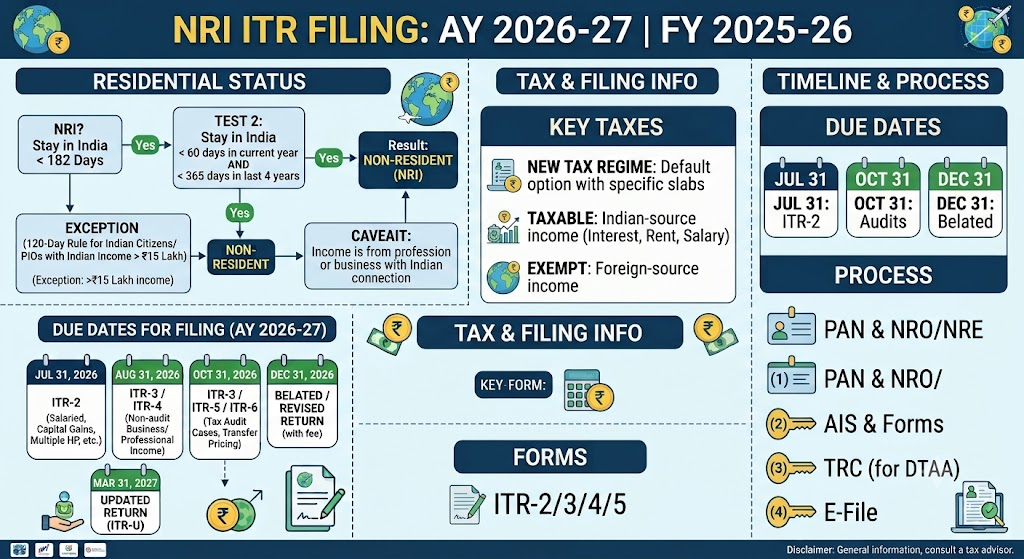
At Adwani & Company, a chartered accountancy practice that has advised clients on Indian tax and regulatory matters for nearly five decades, the questions from NRI clients rarely sound like “do I owe tax.” They sound like: TDS has already been deducted, so do I still need to file? I sold a property in India, can I get a refund of excess TDS? Is interest on my NRO account taxable? Does moving money between my NRE and NRO accounts create a tax event?
This blog answers those questions directly, using the rules applicable for FY 2025-26 (AY 2026-27), and explains why NRI ITR filing is often the single most valuable compliance step an NRI can take before the filing season rush begins.
Do You Really Need NRI ITR Filing? Rethinking the Myth
The residency-based assumption that non-residents are exempt from Indian tax filing is only half true, and the half that is missing matters. Residential status under the Income Tax Act determines how your income is taxed, not whether your India-sourced income is taxed at all. An NRI’s foreign salary, foreign business income, and foreign investment returns stay outside India’s tax net. But income that arises in India rent, capital gains, interest, dividends remains taxable in India regardless of where you live, and once that income crosses the basic exemption threshold, NRI ITR filing becomes a legal obligation, not an optional courtesy.
When NRI ITR Filing Becomes Mandatory in FY 2025-26
For NRIs, filing an Income Tax Return in India is compulsory once total India-sourced income exceeds the basic exemption limit for the relevant year ₹2.5 lakh under the old tax regime, or the higher threshold available under the new regime. Even below that limit, NRI ITR filing is strongly advisable in three common situations: when tax has already been deducted at source and a refund is due,
when the NRI needs proof of filing for a future loan or visa application, or when the NRI wants to carry forward capital losses to offset future gains. Because most NRI income sources rent, NRO interest, capital gains attract deduction of tax at source at fairly steep rates, the second scenario applies to a large share of NRIs even when they assume otherwise.
Rental Income, TDS, and Property Sale: The Real Triggers
Rental income earned from an Indian property is fully taxable in India for an NRI, and tenants are required to deduct TDS before paying rent, typically at 30%. Since the actual tax liability at slab rates is usually lower than the flat TDS rate, NRI ITR filing is the only route to recover that difference as a refund.
Property sale creates a similar, and often larger, gap. When an NRI sells property in India, the buyer must deduct TDS on the transaction under the provisions governing payments to non-residents, and this deduction is calculated on the full sale value rather than on the actual capital gain unless a lower-deduction certificate has been obtained in advance.
This means an NRI can have a substantial amount of money locked up with the Income Tax Department for months, simply because TDS was deducted on the gross consideration instead of the taxable gain. NRI ITR filing is what unlocks that excess deduction and brings it back as a refund.
NRO Interest and NRE-NRO Transfers: What the Law Says
Interest earned on an NRE (Non-Resident External) account is exempt from Indian tax, provided FEMA conditions are met. Interest earned on an NRO (Non-Resident Ordinary) account, however, is fully taxable in India at applicable slab rates, and banks typically deduct TDS at 30% on this interest — again, usually higher than the NRI’s actual tax liability, and again, a reason NRI ITR filing often results in money coming back rather than going out.
As for moving funds between accounts, a straightforward transfer from an NRE account to an NRO account, or vice versa, is not itself a taxable event. What matters is the underlying income: if the funds being transferred originated from taxable Indian income, that income remains taxable regardless of which account it eventually sits in.
Learn more about our NRI Taxation Advisory Services for a structured review of your account-level tax exposure.
Read our detailed guide on NRI ITR Filing 2026: Costly Mistakes & Smart Tax Strategies
Deductions and Reliefs NRIs Can Still Claim
NRIs are not excluded from Chapter VI-A deductions altogether. Section 80C deductions remain available for eligible investments such as life insurance premiums and children’s tuition fees, though certain resident-only instruments like PPF are not open to NRIs. Section 80D deductions for health insurance premiums paid for self, spouse, and dependents also remain available.
NRIs investing in the National Pension System can claim deductions under Section 80CCD. Where India has signed a Double Taxation Avoidance Agreement with the NRI’s country of residence and India now has such agreements with over ninety countries NRI ITR filing is also the mechanism through which DTAA relief is formally claimed, preventing the same income from being taxed twice.
Practical Example An NRI earns ₹9 lakh in interest from an NRO fixed deposit. The bank deducts TDS at 30% (₹2.7 lakh). If actual tax liability at slab rates works out to roughly ₹90,000, the NRI has overpaid by ₹1.8 lakh. Without NRI ITR filing, that amount stays with the Income Tax Department. With a correctly filed return, it is refunded directly to a pre-validated Indian bank account.
Documents Required for NRI ITR Filing
A smooth NRI ITR filing exercise generally requires the following:
- PAN and passport copies confirming NRI status
- Form 26AS and the Annual Information Statement, downloaded from the Income Tax Department’s e-filing portal
- NRE and NRO bank interest certificates
- TDS certificates for rent or property sale
- Housing loan interest certificate, where applicable
- Capital gains statements for any property or securities sold
- A Tax Residency Certificate from the country of residence, where DTAA relief is being claimed
Read our detailed guide on Capital Gains Tax Planning for NRIs for a deeper look at property and securities transactions.
Why Professional Guidance Matters
NRI taxation sits at the intersection of the Income Tax Act, FEMA regulations, and, in many cases, treaty law a combination that rarely rewards a do-it-yourself approach. Dr. Haresh Adwani, who holds a PhD in Commerce and is also a law graduate, brings this combination of taxation and legal expertise to NRI clients at Adwani & Company, helping structure filings so that refunds are claimed correctly the first time and future property transactions, loans, or repatriation of funds are not complicated by earlier compliance gaps. Under
Dr. Haresh Adwani’s guidance, the firm’s NRI practice focuses on getting the residential-status determination right at the outset, since almost every downstream tax question depends on that single classification. For businesses and individuals verifying company-level filings alongside personal NRI returns, cross-checking data available through the Ministry of Corporate Affairs portal is also good practice, since inconsistencies across different regulatory filings can attract scrutiny.
1.Do I need to file an ITR in India if I only earn rental income?
Yes, if that rental income exceeds the basic exemption limit, NRI ITR filing is mandatory. Even below that limit, filing is advisable to claim a refund of TDS deducted by the tenant.
2.TDS has already been deducted on my income. Do I still need to file a return?
Yes. TDS deduction does not close your compliance obligation. NRI ITR filing is how you reconcile the tax actually deducted against your real liability and claim any excess as a refund.
3.I sold a property in India. Can I claim a refund of excess TDS?
In most cases, yes. Since TDS on an NRI’s property sale is usually calculated on the gross sale value rather than the actual capital gain, NRI ITR filing is typically required to recover the difference.
4.Is interest on my NRO account taxable in India?
Yes, NRO account interest is fully taxable at applicable slab rates, unlike NRE account interest, which is exempt.
5.Does transferring money between my NRE and NRO accounts create a tax liability?
The transfer itself is not taxable; what matters is whether the underlying funds represent taxable Indian income.
6.Will NRI ITR filing help with future property purchases or loans in India?
Yes. A consistent filing history strengthens documentation for future property transactions, loan applications, and fund repatriation.
Conclusion: File Before the Rush Begins
NRI ITR filing is not a formality reserved for those who “owe” the government money. For most NRIs with rental income, NRO interest, or a recent property sale, it is the route to a refund that would otherwise sit unclaimed. A few weeks of preparation gathering TDS certificates, reconciling Form 26AS, checking DTAA eligibility can save months of follow-up and a genuinely avoidable tax outflow. Dr. Haresh Adwani and the team at Adwani & Company have guided NRI clients through exactly this process for decades, and the firm’s structured approach means your India tax position is reviewed well before the deadline crunch. If you want expert guidance on NRI ITR filing, connect with Adwani and Company today and get clarity on your compliance position before the filing rush begins.
About the Author
Dr. Haresh Adwani
Ph.D. in Commerce | Law Graduate | Managing Partner, Adwani & Co LLP Dr. Haresh Adwani holds a Ph.D. in Commerce and is a qualified Law graduate with over two decades of hands-on experience in GST advisory, direct taxation, and statutory compliance for businesses across Pune and Maharashtra has guided hundreds of SMEs, startups, and corporates through India’s evolving tax landscape. He is a recognised advisor on GST compliance, company formation, and Virtual CFO services, and regularly contributes to professional seminars and industry forums in Pune.
Don’t risk a defective return notice. Connect with Adwani and Company today for expert ITR filing guidance tailored to your income profile for AY 2026-27.
Disclaimer: This article is published for informational and educational purposes only. It does not constitute legal, financial, or professional tax advice. Tax laws are subject to change; readers are advised to consult a qualified Chartered Accountant or tax professional for advice specific to their circumstances. Content has been prepared with reference to provisions of the Income Tax Act, 1961 and publicly available CBDT guidelines.