Dr. Haresh Adwani, May 2026 13 min Read
Every year, millions of salaried professionals across India face the same season of anxiety income tax filing season. Whether you are a first-time filer or a seasoned employee, income tax filing for salaried individuals in Assessment Year 2026-27 comes with updated rules, revised tax slabs, and critical deadlines that you simply cannot afford to ignore.
Missing a deadline or choosing the wrong tax regime can cost you thousands of rupees in penalties or lost deductions. In this comprehensive guide, Dr. Haresh Adwani a Ph.D. holder in Commerce and a law graduate with deep legal expertise and the team at Adwani and Company break down everything a salaried employee needs to know to file their income tax return (ITR) for AY 2026-27 accurately, confidently, and on time
What is Income Tax Filing for Salaried Individuals?
Income tax filing for salaried individuals is the annual process of reporting your total income earned during a financial year to the Income Tax Department of India and paying any taxes due or claiming a refund if excess tax has been deducted at source (TDS). For AY 2026-27, the relevant financial year is FY 2025-26 (April 1, 2025 to March 31, 2026).
According to the Income Tax Department of India, every individual whose total income exceeds the basic exemption limit or who has TDS deducted is required to file an ITR. For salaried individuals, the applicable form is usually ITR-1 (SAHAJ), provided their total income does not exceed ₹50 lakh and income is from salary, one house property, and other sources.
Filing your ITR for salaried employees AY 2026-27 is not just a legal obligation it also establishes financial credibility, enables visa applications, and is often required for loans or financial products.
Learn more about our ITR Filing Services for Salaried Professionals
Income Tax Slabs for Salaried Individuals AY 2026-27: Old vs New Regime
One of the most important decisions in income tax filing for salaried individuals is choosing between the Old Tax Regime and the New Tax Regime. The government has made the New Tax Regime the default from FY 2024-25 onwards, but salaried employees can still opt for the Old Regime while filing.
New Tax Regime : AY 2026-27 Tax Slabs
- Up to ₹3,00,000 — Nil (0%)
- ₹3,00,001 to ₹7,00,000 — 5%
- ₹7,00,001 to ₹10,00,000 — 10%
- ₹10,00,001 to ₹12,00,000 — 15%
- ₹12,00,001 to ₹15,00,000 — 20%
- Above ₹15,00,000 — 30%
- Rebate u/s 87A: No tax payable if income ≤ ₹7 lakh (under New Regime)
- Standard Deduction: ₹75,000 available under the New Regime for salaried employees
Old Tax Regime : Key Tax Slabs
- Up to ₹2,50,000 — Nil
- ₹2,50,001 to ₹5,00,000 — 5%
- ₹5,00,001 to ₹10,00,000 — 20%
- Above ₹10,00,000 — 30%
- Allows deductions under Section 80C, 80D, HRA, LTA, etc.
Dr. Haresh Adwani advises that the best regime depends on your total deductions. If your eligible deductions exceed ₹3.75 lakh, the Old Regime is likely more beneficial.
Read our detailed guide on Old vs New Tax Regime: Which is Better for You?
Documents Required for Income Tax Filing (AY 2026-27)
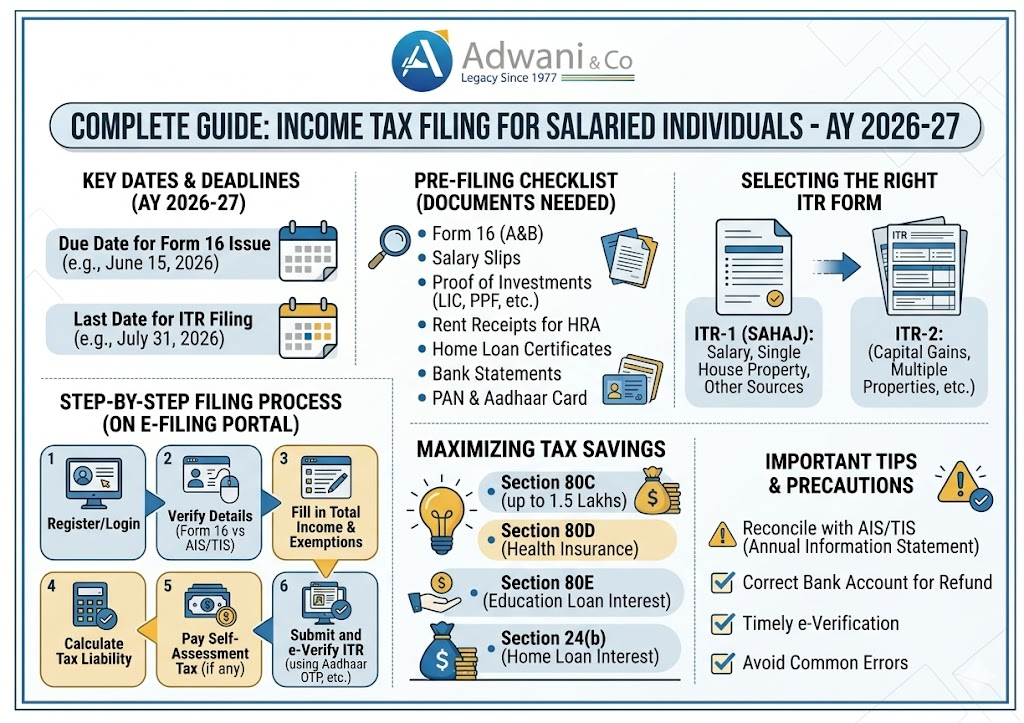
Smooth income tax filing for salaried individuals starts with having the right paperwork. The Income Tax Department advises taxpayers to keep all financial documents ready before initiating the filing process. Here is what you need:
- Form 16 : Issued by your employer; contains salary breakdown and TDS details
- Form 26AS & AIS : Tax credit statement downloadable from the IT portal; verify TDS, advance tax, and high-value transactions
- Bank Statements : For interest income and savings account details
- Investment Proof : PPF, ELSS, LIC, NPS, etc. (for Section 80C claims)
- Home Loan Certificate : For interest deduction u/s 24(b)
- Rent Receipts & HRA Proof : If claiming HRA exemption
- Medical Insurance Premium Receipts : For Section 80D claims
- PAN & Aadhaar : Mandatory for ITR filing and e-verification
Official Source: As per the Ministry of Finance and the Income Tax Department, the Annual Information Statement (AIS) now captures comprehensive financial data including stock transactions, mutual fund purchases, and foreign remittances making it critical to cross-verify before filing.
How to File Income Tax Return Online for Salaried Employees (AY 2026-27)
Filing your income tax return for salaried individuals online is straightforward if you follow the right steps. The Income Tax Department’s e-filing portal (incometax.gov.in) offers a guided filing experience. Here is a step-by-step breakdown:
01. Log In to e-Filing Portal
Visit incometax.gov.in and log in using your PAN and password. New users must register first.
02. Select the Correct ITR Form
Salaried individuals with income below ₹50 lakh select ITR-1 (SAHAJ). Others may need ITR2.
03. Verify Pre-Filled Data
Cross-check auto-populated salary, TDS, and deduction data against Form 16 and AIS carefully.
04. Choose Your Tax Regime
Select Old or New Tax Regime. The system calculates your tax liability for both compare before choosing.
05. Enter Deductions & Income
Fill in all income sources, eligible deductions (80C, 80D, HRA, etc.), and verify the computed tax.
06. Pay Tax & E-Verify
If tax is due, pay via Challan 280. E-verify using Aadhaar OTP, net banking, or DSC within 30 days.
Learn more about our Assisted ITR Filing Service — where experts at Adwani and Company handle the entire filing process on your behalf.
Practical Example: Income Tax Calculation for a Salaried Employee
To understand income tax filing for salaried individuals practically, here is a real-world illustration for AY 2026-27:
Case Study: Priya Mehta, Software Engineer, Mumbai | Annual CTC ₹12,00,000
| Income / Deduction Head | Old Regime (₹) | New Regime (₹) |
| Gross Salary | 12,00,000 | 12,00,000 |
| Standard Deduction | 50,000 | 75,000 |
| Section 80C (PPF + ELSS) | 1,50,000 | Not Applicable |
| Section 80D (Health Insurance) | 25,000 | Not Applicable |
| HRA Exemption | 96,000 | Not Applicable |
| Taxable Income | 8,79,000 | 11,25,000 |
| Total Tax Payable (incl. cess) | ~₹89,388 | ~₹98,800 |
In Priya’s case, the Old Tax Regime saves approximately ₹9,400 more due to her substantial deductions. This is a classic example of why Dr. Haresh Adwani recommends a personalized tax planning consultation before filing your ITR for AY 2026-27.
Common Deductions Available to Salaried Individuals in AY 2026-27
Under the Old Regime, income tax filing for salaried individuals can be significantly optimized through strategic use of deductions. Here are the most impactful ones:
- Section 80C (up to ₹1.5 lakh): PPF, ELSS mutual funds, EPF, LIC premiums, NSC, ULIP, children’s tuition fees, home loan principal repayment
- Section 80D: Health insurance premium up to ₹25,000 (self + family); ₹50,000 for senior citizen parents
- HRA Exemption (Section 10[13A]): For salaried employees paying rent; calculated based on salary, rent paid, and city of residence
- Section 80CCD(1B): Additional ₹50,000 deduction for NPS contributions over and above 80C
- Section 24(b): Home loan interest deduction up to ₹2 lakh on self-occupied property
- Leave Travel Allowance (LTA): Exempt for actual travel within India (2 journeys in a block of 4 years)
- Section 80TTA: Up to ₹10,000 on savings account interest for non-senior citizens
As per MCA and GST Portal guidelines: Professionals with freelance income in addition to salary must also report it under “Income from Business/Profession” and may need to register under GST if annual freelance turnover exceeds ₹20 lakh. Visit GST Portal →
How to Claim TDS Refund : Income Tax Filing for Salaried Employees
One of the most searched topics around income tax filing for salaried individuals is: “How do I get my TDS refund?” If your employer has deducted more tax than your actual liability, the excess amount is refunded by the Income Tax Department after you file your return. Here is how:
- Verify TDS amounts in Form 26AS and Annual Information Statement (AIS)
- Ensure your pre-validated bank account is linked on the e-filing portal
- File your ITR accurately mismatches delay refunds significantly
- E-verify within 30 days of filing; unverified returns are treated as not filed
- Track refund status at incometax.gov.in or via the NSDL TIN portal
Refunds are typically processed within 20–45 days of e-verification if the return is filed without discrepancies, as observed in recent assessments guided by Adwani and Company.
Read our detailed guide on How to Track Your Income Tax Refund Status Online
Critical Mistakes to Avoid in Income Tax Filing for Salaried Individuals
Dr. Haresh Adwani, with years of tax litigation and compliance experience, has identified the most costly errors salaried individuals make during ITR filing for AY 2026-27:
- Wrong ITR Form Selection: Using ITR-1 when ITR-2 is required (e.g., capital gains income or multiple properties)
- Not Reporting All Income: Freelance earnings, interest income, rental income, or dividend income are taxable and must be declared
- Ignoring AIS Mismatches: Discrepancies between your filing and AIS can trigger scrutiny notices from the IT department
- Not E-Verifying the Return: Filing without e-verification renders the ITR invalid
- Missing the Deadline: Late filing attracts a penalty of ₹5,000 (or ₹1,000 if income is below ₹5 lakh) under Section 234F
- Wrong Bank Account Details: Can delay or misdirect your TDS refund
The deadline for income tax filing for salaried individuals for AY 2026-27 is typically July 31, 2026 (subject to official confirmation by the Income Tax Department). Filing early avoids last-minute portal crashes and processing delays.
Frequently Asked Questions:
1. Which ITR form should salaried employees use for AY 2026-27?
Most salaried employees with income up to ₹50 lakh from salary, one house property, and other sources (excluding lottery/capital gains) should use ITR-1 (SAHAJ). Those with capital gains or more than one house property must use ITR-2.
3. Is the New Tax Regime better for salaried individuals in AY 2026-27?
The New Regime is beneficial for individuals with fewer deductions or those earning up to ₹7 lakh (nil tax due to rebate u/s 87A). If you have significant investments under 80C, HRA, home loan interest, or NPS contributions, the Old Regime often results in lower tax outgo. A professional comparison is always advisable.
4. What is the due date for income tax filing for salaried individuals for AY 2026-27?
The standard due date for salaried individuals is July 31, 2026, subject to any official extension by the Income Tax Department. Filing before the deadline avoids the penalty under Section 234F and ensures faster processing of any TDS refunds.
5. Can I file income tax return without Form 16?
Yes. While Form 16 is the primary document for salaried ITR filing, it is possible to file using your salary slips, bank statements, and Form 26AS if your employer has not issued Form 16. Ensure all TDS reflected in Form 26AS is accurately reported in your return.
6. What happens if I file my income tax return late?
Filing a belated return after July 31 attracts a penalty of ₹5,000 under Section 234F (reduced to ₹1,000 if income is below ₹5 lakh). Additionally, you cannot carry forward capital losses, and interest under Sections 234A, 234B, and 234C may apply on outstanding tax dues.
7. How do I claim my TDS refund after income tax filing?
File your ITR accurately and e-verify it within 30 days. Ensure your bank account is pre-validated on the income tax portal. Refunds are typically credited within 20–45 days of successful e-verification. You can track the status on incometax.gov.in under the “Refund/Demand Status” section.
Conclusion:
Income tax filing for salaried individuals for AY 2026-27 is far more than a compliance checkbox it is a powerful financial tool that, when used correctly, can help you recover excess taxes, build a clean financial record, and make the most of every legitimate deduction available to you. With the co-existence of the Old and New Tax Regimes, updated deduction limits, and increasingly sophisticated IT department scrutiny through AIS and Form 26AS, accuracy and timeliness have never been more important.
Whether you are a first-time filer wondering how to file ITR online, an experienced salaried professional optimizing deductions, or someone dealing with multiple income sources, the guidance of a qualified Chartered Accountant can save you both money and compliance headaches. Dr. Haresh Adwani and the expert team at Adwani and Company have helped hundreds of salaried individuals navigate the income tax
Dr. Haresh Adwani , Adwani and Company
Ph.D. in Commerce · Law Graduate · Chartered Accountant with expertise in income tax, corporate law, GST compliance, and financial advisory. Trusted by hundreds of salaried professionals and businesses across India for audit, tax planning, and regulatory compliance.