Income Tax Assessment Proceedings
Most professionals believe that knowing the law is enough to survive income tax assessment proceedings. Years of hands-on experience prove otherwise, and that lesson usually arrives the hard way in a scrutiny room, across a table from an assessing officer, with a client waiting anxiously for answers.
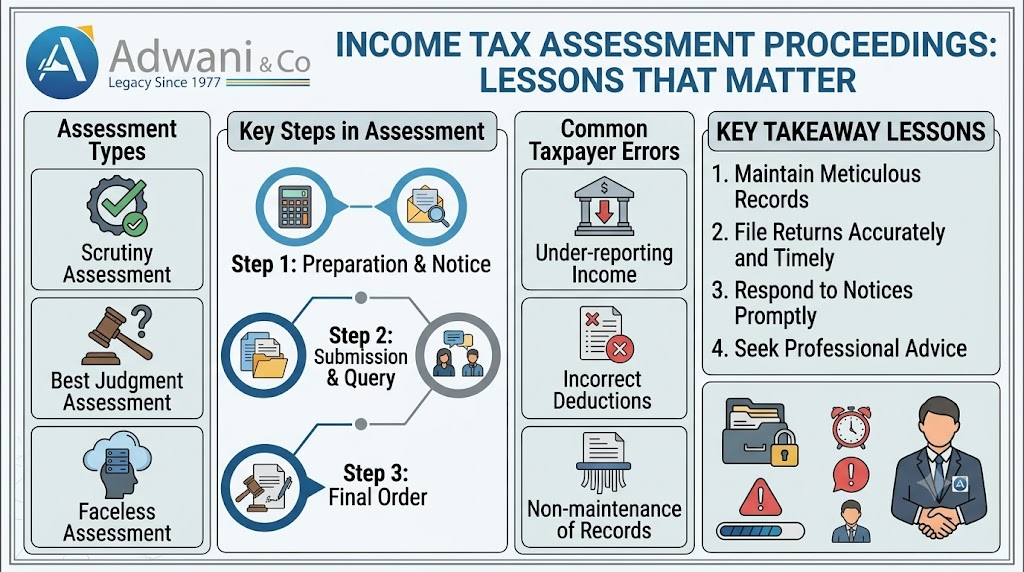
Early in a career built around direct tax advisory, the sections of the Income-tax Act, 1961 feel like the whole game. Section 132, Section 153A, Section 143(3) the provisions are memorised, the timelines are known, the exemptions are on the tip of the tongue. Then real income tax assessment proceedings begin, and a different kind of learning starts.
What Income Tax Assessment Proceedings Actually Involve
Income tax assessment proceedings are not a courtroom debate over legal interpretation alone. They are an examination of facts bank statements, invoices, vendor confirmations, cash flow patterns, and the story those documents tell together. An assessing officer is not only asking “what does the law say,” but also “what do these facts actually show.”
This is where many taxpayers, and even some advisors, get caught off guard. A return that is technically correct can still attract scrutiny if the supporting facts are poorly documented or inconsistently presented. Income tax assessment proceedings reward preparation, not just knowledge of statute.
Why Search and Seizure Changes Everything
If ordinary assessment proceedings test your documentation, an income tax search and seizure action tests your composure. Under Section 132 of the Income-tax Act, authorised officers can enter business or residential premises, examine books of account, and seize cash, jewellery, digital records, and other assets connected to undisclosed income.
What Happens During a Search
A search typically involves:
- Entry and examination of premises by authorised officers
- Statements recorded under oath under Section 132(4), which are admissible as evidence
- Seizure of unexplained assets, documents, and digital data
- Preparation of a panchnama listing everything examined and seized
Following a search, the department can initiate block assessment proceedings under Section 153A, covering up to six assessment years prior to the search year, in addition to the current year. This is a serious escalation from a routine notice, and it changes the entire posture of income tax assessment proceedings that follow.
The Real Cost of a Poorly Handled Response
Search and seizure matters rarely resolve quickly. Statements recorded during a search carry weight in later assessment proceedings, and an admission made under pressure is difficult to walk back later. This is precisely why calm, evidence-based responses matter more than fast ones. Patience during income tax assessment proceedings is not passivity it is discipline.
A Practical Example
Consider a business reporting turnover of ₹1.4 crore in its GST returns, while its financial statements filed with the Ministry of Corporate Affairs (MCA) show turnover of ₹1.65 crore.
Example: A ₹25 lakh mismatch between GST turnover and MCA financial statements is exactly the kind of gap that automated data-matching systems flag for review.
That gap, however innocent the explanation, is exactly the kind of mismatch that data-matching systems flag. Once flagged, the case can move from a routine query to full-fledged income tax assessment proceedings, with the burden falling on the taxpayer to reconcile the difference convincingly. A well-documented explanation, prepared in advance, can resolve this in a single hearing. A defensive, unprepared response can stretch it across months. Cases like this are exactly why Dr. Haresh Adwani, PhD in Commerce and a practising law graduate, insists on reconciling the numbers before drafting any reply.
Read our Detiled guide on ITR Filing Mistakes That Can Cost You Months, Not Minutes
Beyond Knowing the Law: What Assessment Proceedings Demand
Real income tax assessment proceedings teach three things that no textbook fully captures:
- Facts must be examined as carefully as the law. A correct legal position built on shaky facts rarely survives scrutiny.
- The other side has a perspective too. Understanding how an assessing officer reads a case changes how a response is drafted.
- Not every matter resolves on your timeline. Search and seizure cases, in particular, demand patience alongside preparation.
At Adwani & Company, this philosophy shapes how income tax assessment proceedings and search cases are handled — not as a purely legal exercise, but as a careful balance of facts, documentation, and legal interpretation.
The Advisor’s Role: A Bridge, Not Just a Consultant
Over years of handling assessment proceedings, search cases, and appeals, the role of a tax advisor shifts. It stops being purely about giving advice and starts being about building a bridge between the client and the tax administration, between the facts on record and the law that applies to them, between a difficult notice and the right way forward.
Dr. Haresh Adwani, a PhD holder in Commerce and a law graduate, brings exactly this combination to income tax assessment proceedings at Adwani & Company. His dual grounding in commerce and law allows him to read a case the way an assessing officer might, while still building the strongest possible position for the client. This blend of tax expertise and legal training is central to how the firm approaches search and seizure matters and other high-stakes income tax assessment proceedings.
Clients facing income tax assessment proceedings often arrive anxious, assuming the worst. Dr. Haresh Adwani’s approach, refined over years of litigation and scrutiny work, is to slow the process down first establish the facts, understand the notice, and only then decide the strategy. This is a markedly different approach from firms that rush to respond without full documentation in hand.
How to Prepare for Income Tax Assessment Proceedings
A few habits consistently separate smooth outcomes from prolonged disputes:
- Reconcile regularly match GST returns: income tax filings, and MCA financial statements periodically, not just at year-end
- Document as you go : keep vendor confirmations, bank narrations, and supporting evidence organised in real time
- Respond, don’t react: a notice deserves a considered reply, not an immediate, unprepared one
- Know your rights during a search : review the panchnama carefully before signing, and note objections where warranted
- Get experienced representation early : the framing of your first response to income tax assessment proceedings often shapes the outcome of everything that follows
Government Authority and Compliance Signals
Guidance available through the Income Tax Department and the Ministry of Corporate Affairs (MCA) continues to emphasise cross-verification between GST filings, income tax returns, and company filings. Businesses that treat these as separate silos are the ones most likely to face unexpected income tax assessment proceedings.
Learn more about our Income Tax Litigation Support to understand how integrated compliance reduces this risk. Read our detailed guide on GST Notice 2026 Compliance for a related look at how automated cross-matching triggers scrutiny.
1. What triggers income tax assessment proceedings?
Mismatches between GST returns, income tax filings, MCA records, high-value transactions, or information received from a search can all trigger income tax assessment proceedings.
2. How long do income tax assessment proceedings usually take?
Timelines vary by case complexity. Straightforward scrutiny may close within a few hearings, while search-related block assessments under Section 153A can extend over months given the six-year assessment window involved.
3. What should I do if I receive an income tax notice?
Read it carefully, gather the relevant documentation, and respond with facts rather than assumptions. Avoid reacting before understanding exactly what the notice is asking.
4. Can statements made during a search be used later?
Yes. Statements recorded under Section 132(4) during a search are admissible as evidence in subsequent assessment and penalty proceedings, which is why careful, honest responses matter at every stage.
5. Do small businesses face income tax assessment proceedings too?
Yes. Automated data matching across GST, income tax, and MCA systems means businesses of every size can face income tax assessment proceedings, not just large corporations.
Conclusion
Income tax assessment proceedings are rarely just about the law. They are about facts, patience, and the ability to see a case from more than one side. If you are facing a notice, a scrutiny case, or a search and seizure matter, connect with Adwani and Company today for experienced, fact-based representation.
About the Author
Dr. Haresh Adwani
Ph.D. in Commerce | Law Graduate | Managing Partner, Adwani & Co LLP Dr. Haresh Adwani holds a Ph.D. in Commerce and is a qualified Law graduate with over two decades of hands-on experience in GST advisory, direct taxation, and statutory compliance for businesses across Pune and Maharashtra. As Managing Partner of Adwani & Co LLP a firm established in 1977 by Advocate N. T. Adwani Dr. Adwani has guided hundreds of
SMEs, startups, and corporates through India’s evolving tax landscape. He is a recognised advisor on GST compliance, company formation, and Virtual CFO services, and regularly
contributes to professional seminars and industry forums in Pune.
Disclaimer: This article is intended for informational purposes only and does not constitute legal, tax, or professional advice. Every case involving income tax assessment proceedings depends on its own facts, and readers should consult a qualified tax professional before acting on any information contained here.