Income Below ₹12 Lakh?
ITR Filing Below 12 Lakh Still Matters
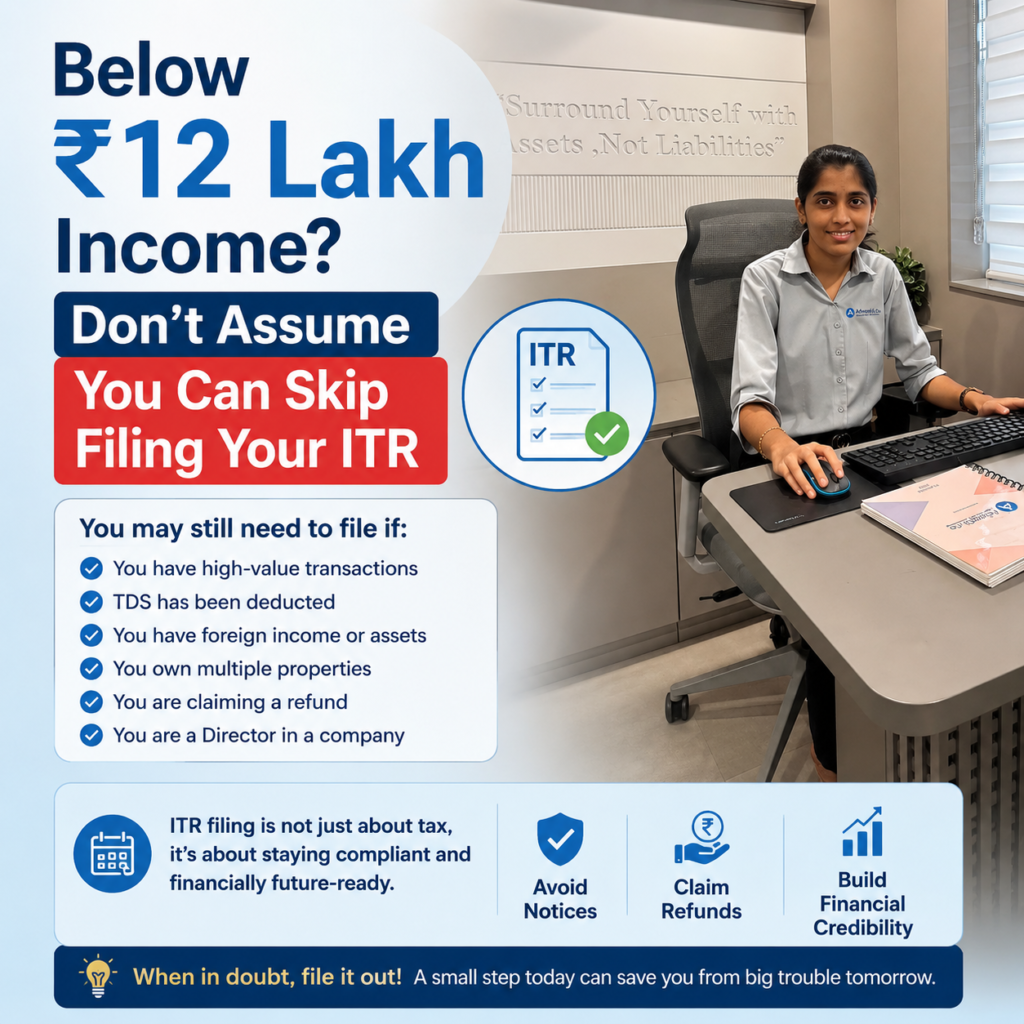
“₹12 lakh” has become shorthand for “no tax” this filing season. Thanks to the enhanced Section 87A rebate, income up to ₹12 lakh under the new tax regime now attracts zero tax liability for AY 2026-27. But a dangerous myth has grown alongside this relief: many taxpayers assume that if their income sits below ₹12 lakh, they can skip filing an Income Tax Return altogether. That assumption is wrong and it can cost you a refund, delay a loan approval, or invite a penalty notice. Understanding the real rules around ITR filing below 12 lakh income is essential before you decide to sit this filing season out.
The ₹12 Lakh Rebate vs the ITR Filing Below 12 Lakh Requirement
The Section 87A rebate and the requirement to file are governed by two completely different provisions of the Income Tax Act, and conflating them is the root of the confusion around ITR filing below 12 lakh income.
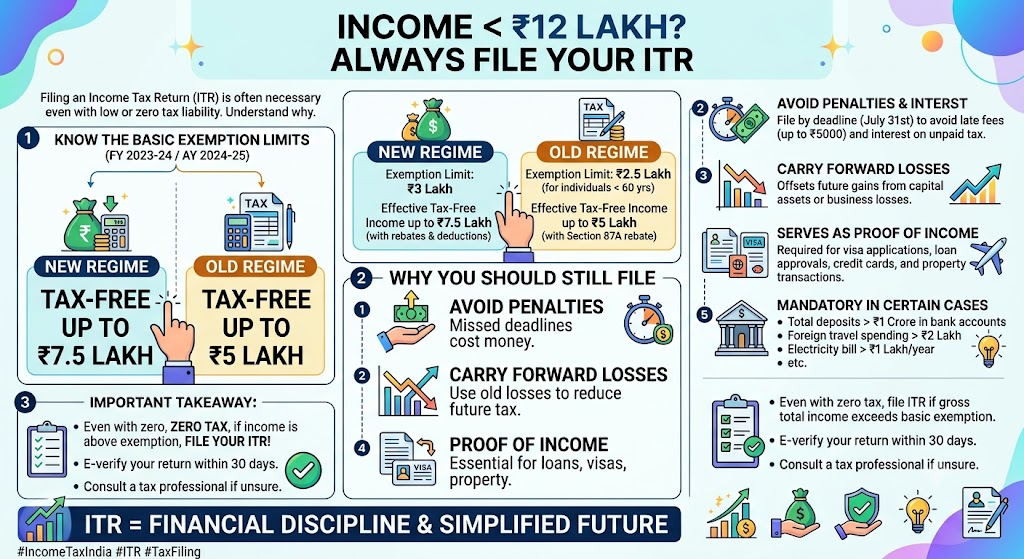
The rebate under Section 87A brings your tax liability to nil if your taxable income does not exceed ₹12 lakh under the new regime (or ₹5 lakh under the old regime). But your obligation to file a return is tied to your gross total income before deductions crossing the basic exemption limit currently ₹4 lakh under the new regime and ₹2.5 lakh under the old regime. A taxpayer earning ₹10 lakh may pay zero tax after the rebate, yet their gross income of ₹10 lakh is still well above the ₹4 lakh exemption limit, which means ITR filing below 12 lakh income remains legally mandatory in this case.
Key Distinction
- Zero tax liability (Section 87A rebate) does not mean zero filing obligation.
- Filing depends on gross total income crossing the exemption limit, not on the tax finally payable.
The exemption limit is far lower (₹4 lakh) than the ₹12 lakh rebate threshold.
When Is ITR Filing Below 12 Lakh Income Legally Mandatory?
Beyond the basic exemption limit, the seventh proviso to Section 139(1) lists specific high-value transactions that trigger mandatory ITR filing below 12 lakh income even when no tax is due. You must file a return if, during the year, you have:
- Deposited ₹1 crore or more in one or more current bank accounts
- Deposited ₹50 lakh or more in one or more savings bank accounts
- Spent ₹2 lakh or more on foreign travel for yourself or another person
- Paid electricity bills exceeding ₹1 lakh in aggregate during the year
- Earned business turnover above ₹60 lakh or professional receipts above ₹10 lakh
- Had TDS or TCS of ₹25,000 or more deducted (₹50,000 for senior citizens)
- Owned, held signing authority in, or benefited from any foreign asset or foreign bank account
Meeting even one of these conditions is enough to make ITR filing below 12 lakh income compulsory, irrespective of your final tax liability.
A Practical Example of ITR Filing Below 12 Lakh Obligation
Consider Mr. Sharma, a salaried professional with a gross annual income of ₹10.5 lakh under the new tax regime. After the standard deduction and Section 87A rebate, his tax liability works out to nil. He assumes this means he has no filing obligation this year.
However, Mr. Sharma spent ₹2.3 lakh on a family holiday abroad and maintains a savings account balance that saw deposits of ₹55 lakh during the year. Both facts independently trigger the seventh proviso to Section 139(1). Despite owing zero tax, Mr. Sharma is legally required to complete ITR filing below 12 lakh income and skipping it would expose him to penalty under Section 234F and possible scrutiny notices.
Why ITR Filing Below 12 Lakh Income Is Still Worth Doing
Even where filing is not strictly mandatory, voluntary ITR filing below 12 lakh income carries real advantages:
- Claiming a refund of excess TDS deducted by your employer or bank
- Building a verifiable income record for loan, credit card, or visa applications
- Carrying forward capital losses or business losses to set off against future income
- Reducing the chance of receiving a compliance or mismatch notice later
- Strengthening your overall financial credibility with banks and regulators
How to Check Your ITR Filing Below 12 Lakh Obligation
1: Compute Gross Total Income Before Deductions
Add up your salary, house property income, capital gains, and other income before claiming any Chapter VI-A deductions. Compare this figure with the basic exemption limit applicable to your regime and age.
2: Review the Seventh Proviso Conditions
Check your bank statements, electricity bills, and foreign travel spending against the thresholds listed above.
3: Check TDS and TCS Credited to Your PAN
Review your Annual Information Statement (AIS) and Form 26AS on the
4: Consult a Professional When in Doubt
Where multiple income heads, foreign assets, or high-value transactions are involved, professional review of your ITR filing below 12 lakh obligation prevents costly errors.
Common Mistakes Taxpayers Make on ITR Filing Below 12 Lakh Income
- Assuming nil tax under Section 87A automatically means no filing is required
- Overlooking mandatory foreign asset and foreign income disclosure requirements
- Missing out on legitimate TDS refunds by not filing at all
- Selecting the wrong ITR form for their income profile
- Ignoring high-value transaction thresholds under the seventh proviso
Expert Guidance on ITR Filing Below 12 Lakh Cases
GST law and income tax compliance today involve accounting, procedural, and legal interpretation working together. Dr. Haresh Adwani, PhD (Commerce) and a law graduate, brings this combined expertise to questions around ITR filing below 12 lakh income, helping clients distinguish between tax liability and filing obligation with confidence.
At Adwani & Co LLP, clients receive a structured review of their income profile, high-value transactions, and TDS position before every filing season, ensuring ITR filing below 12 lakh income decisions are backed by an accurate, documented assessment rather than guesswork.
Under Income Tax Department guidance and the seventh proviso to Section 139(1), the responsibility to evaluate your own filing obligation rests with the taxpayer — which is exactly where Dr. Haresh Adwani and the team at Adwani & Co LLP add the most value.
Learn more about our Income Tax Return Filing Services. Read our detailed guide on GST Notice Compliance for Businesses.
Key Takeaways on ITR Filing Below 12 Lakh Income
- The ₹12 lakh Section 87A rebate removes your tax liability, not your filing obligation.
- ITR filing below 12 lakh income is mandatory once gross income crosses ₹4 lakh (new regime) or specified high-value transactions apply.
- Filing voluntarily helps you claim TDS refunds, carry forward losses, and build financial credibility.
When in doubt, verify your eligibility against the seventh proviso to Section 139(1) instead of assuming.
Do I need to file ITR if my income is below ₹12 lakh?
Possibly yes. Filing depends on your gross total income crossing the ₹4 lakh (new regime) exemption limit or meeting specified high-value transaction conditions, not on whether tax is finally payable.
Is ITR filing mandatory if my tax is nil under Section 87A?
Yes, if your gross income before deductions exceeds the basic exemption limit or you meet any seventh proviso condition, ITR filing below 12 lakh income remains mandatory despite nil tax.
What happens if I skip filing despite being required to?
You may face a late fee under Section 234F, interest under Section 234A, loss of the right to carry forward losses, and possible scrutiny notices.
Can I claim a TDS refund without filing an ITR?
No. Filing a return is the only mechanism to claim a refund of excess TDS or TCS deducted during the year.
What is the ITR filing deadline for AY 2026-27?
For most salaried individuals and HUFs without audit requirements, the due date is 31st July 2026; audit cases generally fall due by 31st October 2026.
Conclusion: Don’t Let the ₹12 Lakh Myth Cost You
The ₹12 lakh rebate is genuine relief, but it answers only one question how much tax you owe. It does not answer whether you must file. Treat ITR filing below 12 lakh income as a compliance and financial-planning decision, not an assumption. Review your gross income, your high-value transactions, and your TDS position each year before deciding to skip filing.
About the Author
Vaishnavi Hole is a CA Finalist and Direct Tax Associate at Adwani & Co LLP, specializing in direct taxation, income tax compliance, and advisory services. She is passionate about simplifying complex tax laws into practical, easy-to-understand insights for businesses and individuals. Through her articles, Vaishnavi shares well-researched perspectives on direct tax developments, compliance, and regulatory updates to help readers make informed financial decisions.
If you want expert guidance on your ITR filing below 12 lakh obligation, connect with Adwani & Co LLP today for a documented, professional review before the AY 2026-27 deadline.
Disclaimer
This article has been prepared by Adwani & Co LLP for general informational and educational purposes only. It does not constitute professional tax, legal, or financial advice and should not be relied upon as a substitute for consultation with a qualified chartered accountant. Readers should seek independent professional advice from Adwani & Co LLP before acting on any information contained herein, based on their specific facts and circumstances.