
HUF Capital Gains Tax Exemption
A client walked into a recent review meeting convinced he had found a clever way to double his family’s tax-free investment gains. He had built a healthy equity portfolio over the years and already knew that long-term capital gains on listed shares and equity mutual funds enjoy an exemption of ₹1.25 lakh under
Section 112A of the Income Tax Act. His question was simple but sharp: if he created a Hindu Undivided Family and routed his investments through it, could his family claim a second ₹1.25 lakh exemption? The honest answer is that the structure works beautifully on paper and falls apart the moment you ask where the HUF actually got its money. If you are weighing the HUF capital gains tax exemption as part of your own wealth planning, this is the conversation that needs to happen before, not after, you move a single share.
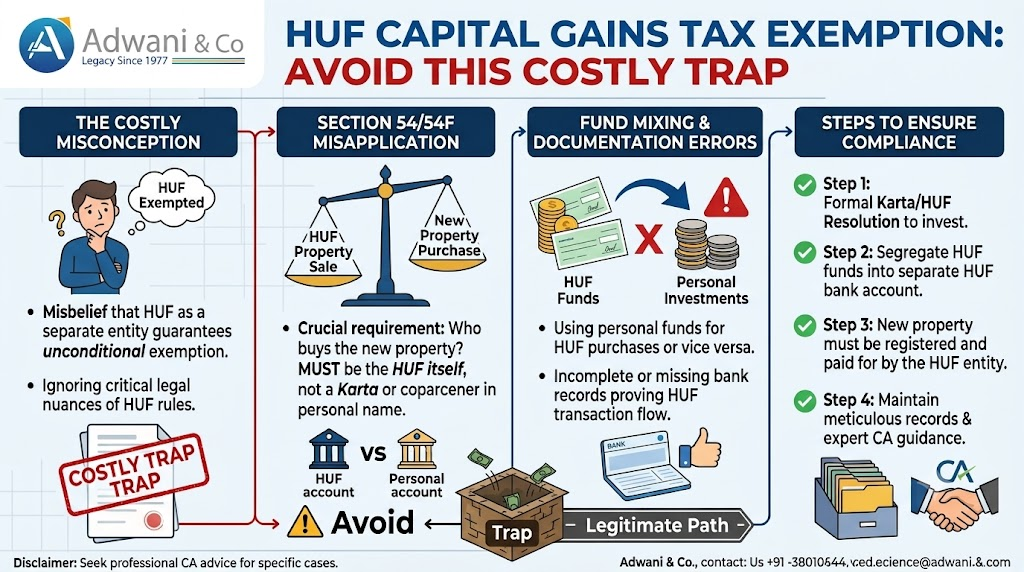
What Is a HUF? Understanding the HUF Capital Gains Tax Exemption Opportunity
A Hindu Undivided Family, or HUF, is one of the few entities Indian tax law treats as a fully independent taxpayer without requiring formal incorporation. It comes into existence automatically the moment a Hindu, Buddhist, Jain, or Sikh family holds joint ancestral property or descends from a common ancestor, and it is recognised as a separate “person” under Section 2(31) of the Income Tax Act.
That separateness is precisely what makes the HUF capital gains tax exemption attractive: a HUF can hold its own PAN, operate its own bank account and Demat account, and file its own Income Tax Return, completely apart from the personal returns of its individual members, including the Karta who manages its affairs.
Dr. Haresh Adwani, founder of Adwani and Company and a PhD holder in Commerce with formal legal training, often points out to clients that this independence is a genuine planning tool, not a loophole provided the HUF’s income actually belongs to the HUF in substance, not merely on paper.
Section 112A and the ₹1.25 Lakh HUF Capital Gains Tax Exemption Explained
Section 112A governs the taxation of long-term capital gains arising from the sale of listed equity shares, units of equity-oriented mutual funds, and units of business trusts, provided Securities Transaction Tax has been paid and the holding period exceeds twelve months. Gains up to ₹1.25 lakh in a financial year are exempt, and anything above that threshold is taxed at a flat 12.5% without the benefit of indexation. This rule applies uniformly to every taxpayer who qualifies as an assessee under the Act individuals, HUFs, and other eligible entities alike.
How the Exemption Works for an Individual Investor
Consider an individual who books listed-share gains of ₹3 lakh in a financial year. The first ₹1.25 lakh is exempt, and tax at 12.5% applies only to the remaining ₹1.75 lakh, working out to roughly ₹21,875 before cess. This straightforward mechanism is what makes equity investing tax-efficient for most retail investors, and it is exactly why a second exemption through a HUF looks so appealing.
Can a HUF Really Claim Its Own HUF Capital Gains Tax Exemption?
Technically, yes. Since a HUF is assessed independently, it is entitled to its own annual ₹1.25 lakh threshold under Section 112A, separate from the exemption already available to the Karta or any other member in their individual capacity. This is the part of the answer that excites most clients and the part that, on its own, is incomplete.
Read our detailed guide on Capital Gains Tax India 2025: Your Complete Guide to Save More and Pay Less
The Real Question Behind Every HUF Capital Gains Tax Exemption Claim
The more important question is rarely asked early enough: where did the HUF get the money to buy those shares in the first place? If the Karta simply moves his personal shares or personal funds into the HUF’s Demat account or bank account, the structure stops being a genuine second taxpayer and starts looking like an attempt to split one person’s income into two tax returns. The source of funds, not the existence of the HUF itself, is what determines whether the exemption holds up under scrutiny.
Section 64(2): The Clubbing Trap That Can Void Your HUF Capital Gains Tax Exemption
Section 64(2) of the Income Tax Act was drafted specifically to close this gap. It provides that when an individual member of a HUF converts or transfers their own separate property into property belonging to the family without adequate consideration, the individual is deemed to have transferred that property through the family, and any income including capital gains arising from it continues to be taxed in the individual’s hands, not the HUF’s.
As Dr. Haresh Adwani frequently advises clients at Adwani and Company, this single provision is the difference between a HUF capital gains tax exemption that actually saves tax and one that exists only on the income tax portal.
A Practical Example of How Clubbing Defeats the Exemption
WORKED EXAMPLE
Suppose Rajesh, the Karta of his HUF, transfers listed shares worth ₹18 lakh from his personal Demat account into his HUF’s account without receiving anything in return. Fourteen months later, the HUF sells these shares for ₹20.5 lakh, booking a long-term capital gain of ₹2.5 lakh.
If the HUF were treated as the rightful owner, it would apply its own ₹1.25 lakh exemption under Section 112A and pay tax of roughly ₹15,625 on the balance. But because Rajesh converted his own separate property into HUF property without consideration,
Section 64(2) deems the entire gain to arise in his hands. If Rajesh has already used his personal exemption elsewhere that year, the full ₹2.5 lakh gets added to his own taxable income and taxed at 12.5% a liability of roughly ₹31,250, reported on his personal return rather than the HUF’s. The “saving” he expected becomes a more expensive outcome than if the HUF had never existed.
How to Build a Genuine Corpus for a Valid HUF Capital Gains Tax Exemption
A HUF capital gains tax exemption holds up when the underlying corpus genuinely belongs to the family rather than to one member acting through it. Funding sources that generally stand on firmer ground include:
- Ancestral property or assets that have devolved to the HUF by succession, rather than by an individual member’s transfer
- Gifts received directly by the HUF from relatives who are not themselves members of that HUF, such as a member’s parents-in-law
- Property received by the HUF as a named beneficiary under a registered will
- Income generated by a business or investment activity that the HUF carries on in its own right
Where reinvestment is involved for instance, the HUF using gains from one investment to fund another it is worth treating each step cautiously, since the “income tracing” principle behind Section 64(2) is interpreted broadly by tax authorities. The safest course is always to document the original source of every rupee that enters the HUF’s accounts.
Read our detailed guide on Clubbing of Income and Capital Losses Under Section 64(1)(iv) for how the same income-tracing principle plays out for transfers to a spouse rather than a HUF.
New Income Tax Act 2025: What Changes for the HUF Capital Gains Tax Exemption
From 1 April 2026, the Income Tax Act, 1961 has been replaced by the Income Tax Act, 2025, reorganising the law into a leaner set of chapters and sections. The good news for anyone planning around the HUF capital gains tax exemption is that the substance has not changed only the addresses have. Section 112A is now Section 198, and the clubbing provision under Section 64(2) is now Section 99(2).
Dr. Haresh Adwani notes that taxpayers filing returns for Tax Year 2026-27 onward should get comfortable with the new numbering, while income earned up to 31 March 2026 continues to be governed by the old Act’s section references for that year’s assessment. For the current, authoritative text of either Act, the Income Tax Department’s official e-filing portal and circulars issued by the Central Board of Direct Taxes remain the most reliable sources.
Common Mistakes That Cost Taxpayers Their HUF Capital Gains Tax Exemption
In practice, most HUF capital gains tax exemption claims run into trouble for a handful of repeated reasons:
- Transferring personal shares, mutual fund units, or cash directly into the HUF and assuming the income automatically belongs to the HUF
- Failing to execute or retain documentation gift deeds, wills, partition deeds that proves where the HUF’s funds actually came from
- Overlooking that the clubbing rule survives even if the converted property is later partitioned among family members
- Assuming every rupee earned by the HUF, including reinvested or “second-generation” income, automatically escapes Section 64(2) without checking the specific facts
- Filing the wrong ITR form, or omitting Schedule 112A disclosures, when reporting the HUF’s gains
KEY TAKEAWAYS
- A HUF is a separate taxpayer with its own PAN, bank account, Demat account, and ITR, and is entitled to its own ₹1.25 lakh exemption under Section 112A.
- The HUF capital gains tax exemption only holds up if the HUF’s investment corpus is genuinely its own not money or shares simply moved over by a member.
- Section 64(2) clubs income from property converted into HUF property by a member without adequate consideration back into that member’s personal income.
- From Tax Year 2026-27, Section 112A is renumbered Section 198 and Section 64(2) is renumbered Section 99(2) under the Income Tax Act, 2025.
Ancestral assets, gifts from non-members, inheritance under a will, and the HUF’s own business income are the more reliable ways to fund a genuine HUF corpus.
1.Can a HUF claim a separate ₹1.25 lakh exemption under Section 112A?
Yes. Because a HUF is treated as an independent person under the Income Tax Act with its own PAN and tax return, it is entitled to its own ₹1.25 lakh annual exemption on long-term capital gains from listed equity shares and equity mutual funds under Section 112A, separate from the exemption available to its individual members.
2.What happens if I transfer my own shares to my HUF?
If a member transfers personal shares or funds to the HUF without adequate consideration, the Section 64(2) clubbing provisions apply, meaning any capital gains or other income arising from those shares will be taxed in the transferring member’s hands, not the HUF’s defeating the purpose of claiming a separate HUF capital gains tax exemption.
3.Does Section 64(2) apply to gifts received by the HUF from my parents or in-laws?
Generally no. Gifts received by the HUF from a member’s parents, in-laws, or other persons who are not themselves members of that HUF typically fall outside the clubbing net under Section 64(2), making such gifts a more reliable way to build a genuine corpus, though documentation and the facts of each case matter.
4.How does the new Income Tax Act 2025 affect HUF capital gains tax exemption rules?
The Income Tax Act, 2025 replaced the Income Tax Act, 1961 from 1 April 2026. The substance is unchanged, but Section 112A is now Section 198 and Section 64(2) is now Section 99(2), so HUFs filing returns for Tax Year 2026-27 onward should reference the updated numbering.
5.Which ITR form should a HUF use to claim the Section 112A exemption?
A HUF reporting long-term capital gains under Section 112A typically files ITR-2, or ITR-3 if it has business income, disclosing the gains in Schedule 112A along with supporting transaction details.
6.Can my HUF buy shares directly so the exemption is never at risk?
Yes. If the HUF invests using funds genuinely belonging to it such as ancestral assets, gifts from non-members, or its own business income there is no transfer from an individual member attracting Section 64(2), and the HUF can claim its capital gains tax exemption cleanly.
Final Word: Plan Your HUF Capital Gains Tax Exemption the Right Way
A HUF can be a legitimate and valuable part of a family’s tax planning, and the HUF capital gains tax exemption is real not a myth. What separates a sound structure from a risky one is rarely the paperwork of creating the HUF; it is the discipline of tracing every rupee that funds it back to a source the law recognises as genuinely belonging to the family.
As Dr. Haresh Adwani puts it, the right question is never “who sold the shares,” but “who owned the funds that bought them in the first place.” Before you transfer assets into a HUF or restructure an existing one, it is worth having that conversation with a qualified Chartered Accountant who can review your specific facts.
Author
CA Dipesh Gurubakshani is a Chartered Accountant with Adwani & Co LLP, Pune, specialising in income tax audit, direct taxation, and accounting advisory. He supports clients across statutory compliance, financial reporting, and income tax matters with a focus on accuracy, regulatory adherence, and disciplined execution.
Legal Disclaimer: This article is published for informational and educational purposes only. Nothing contained herein constitutes legal, financial, or tax advice, nor should it be treated as a substitute for professional consultation tailored to your specific circumstances. Tax laws, rates, and provisions are subject to change; readers are strongly advised to consult a qualified Chartered Accountant or tax advisor before acting on any information in this article.
All content is original. References to government portals and statutory provisions are paraphrased for educational purposes in compliance with fair use principles. No content has been reproduced from third-party sources
The key takeaway: the law treats profit and loss from the same source consistently. And with the right professional guidance like that offered by Adwani and Company you can ensure that every legitimate tax benefit is claimed correctly and defensibly.