
Most business owners check their bank balance to understand how their company is doing. If the number looks healthy, they assume things are fine. If it looks tight, they start worrying. But here is the problem your bank balance tells you where you’ve been, not where you’re going.
This is exactly where financial modeling and FP&A (Financial Planning & Analysis) change thegame. Done properly, they turn reactive finance into proactive strategy helping founders, growing businesses, and even established SMEs understand not just what happened, but
what is likely to happen next and what decisions they should take today.
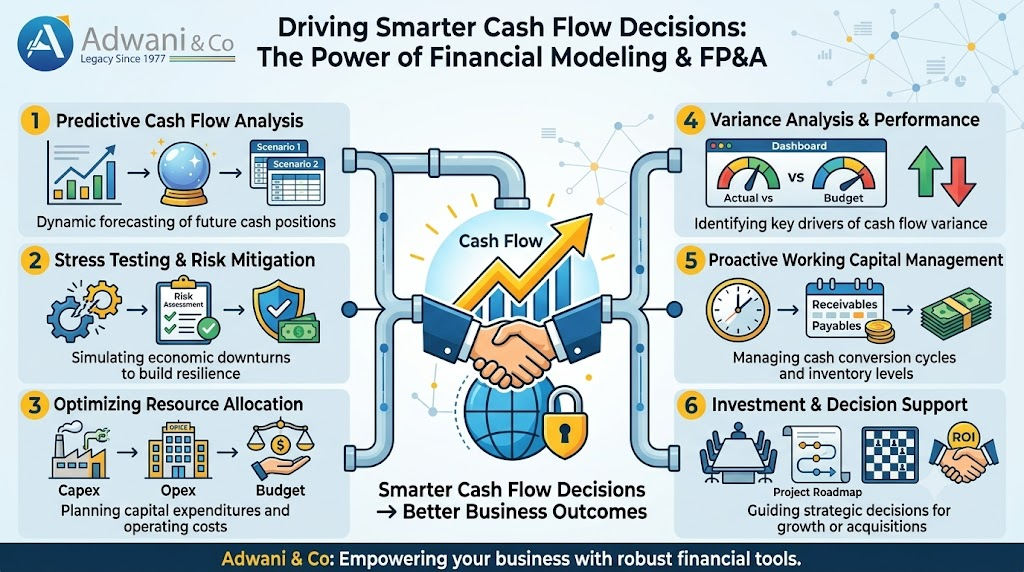
What Is Financial Modeling And Why Does It Matter Beyond Large Corporates?
Financial modeling is often seen as something reserved for investment bankers, analysts, and large enterprises raising capital. In practice, it is one of the most powerful tools
available to any business owner who wants to run their company with financial clarity.
A financial model is essentially a structured representation of your business’s financial performance built in a spreadsheet or planning tool that links your revenue
assumptions, cost structure, working capital needs, and cash position into a single, dynamic view. When built correctly, you can change one assumption (say, a 10% drop in sales) and
immediately see the downstream impact on gross margin, operating profit, and cash flow.
For founders and SMEs, this kind of visibility is not a luxury it is a necessity.
The Real Problem: Running a Business Without a Forward-Looking Financial View
In the course of working with businesses across sectors and geographies, one pattern appears consistently: companies that struggle with cash flow surprises almost always lack a
forward-looking financial model. They may have clean books. They may have a good accountant. But without a rolling cash
flow forecast tied to their actual business assumptions, they are essentially driving with no headlights.
Here are the situations where this gap becomes most visible:
- A business wins a large contract but runs out of working capital to deliver it.
- A founder plans to hire aggressively without stress-testing the payroll impact on runway.
- A growing company misses a tax payment or vendor obligation because cash timing.
- An SME takes on debt without understanding whether projected cash flows can comfortably service it.
None of these situations are inevitable. They are all manageable with the right financial
Where FP&A Fits In: Connecting the Numbers to Business Decisions
FP&A, or Financial Planning & Analysis, sits at the intersection of finance and business strategy. It is the function that takes raw financial data and converts it into actionable business insight.
While financial modeling provides the structure, FP&A provides the ongoing rhythm monthly reviews, budget-vs-actual comparisons, rolling forecasts, and variance analysis that helps leadership understand whether the business is on track and what needs to change.
Key Components of a Strong FP&A Function
- Budgeting and Planning : Setting annual financial targets that are tied to realistic business assumptions not just last year’s numbers with a 10% growth assumption tacked on.
- Rolling Cash Flow Forecasts: A 12-week or 13-period rolling cash flow forecast that tracks receivables, payables, payroll, debt service, and tax obligations gives businesses a live view
of liquidity risk. - Variance Analysis Comparing actual performance against plan and more importantly, understanding why variances occurred and what they signal for the next period.
- Scenario Planning What happens if a key client churns? What if raw material costs rise 15%? What if the business grows 30% faster than planned? Scenario modeling answers
these questions before they become crises. - MIS Reporting: Monthly management information system reports that consolidate performance metrics, KPIs, and financial summaries into a format that supports confident
decision-making at the leadership level.
Also Read : FP&A and Excel Automation: The CFO’s Secret Weapon for Smarter Decisions in 2026
Cash Flow Modeling: The Most Critical Output
Of all the outputs financial modeling produces, cash flow forecasting is arguably the most critical particularly for startups, SMEs, and businesses in growth phases. Profit on paper does not equal cash in the bank. A business can be profitable on its income
statement while simultaneously facing a cash crunch particularly if it is growing fast, extending credit to clients, or carrying inventory. This is one of the most misunderstood
realities in business finance.
A well-structured cash flow model accounts for:
- Operating cash flows collections from customers, payments to vendors, payroll, taxes
- Investing activities capital expenditures, asset acquisitions, technology investments
- Financing flows loan drawdowns, repayments, equity infusions, dividend payments
Common Financial Modeling Mistakes That Businesses Should Avoid
Based on practical experience across multiple client engagements, CA Manish R. Mata has observed that financial modeling errors often stem not from complexity, but from avoidable structural mistakes:
Overly optimistic revenue assumptions: Models built on best-case scenarios rather than base-case reality tend to mislead more than they guide.
Ignoring working capital timing: Many models project revenue and profit accurately but fail to account for the time lag between invoicing, collection, and actual cash receipt.
No sensitivity or scenario analysis : A model that only shows one version of the future is not a planning tool; it is a point-in-time estimate with limited strategic value.
Disconnected from actual books: A financial model that is not reconciled to actual accounting data quickly becomes irrelevant. The model and the books must speak to each other.
Not updated regularly : A financial model built six months ago and never refreshed is worse than no model at all. It creates false confidence.
Who Needs Financial Modeling and FP&A Support?
At Adwani & Co LLP, we bring hands on FP&A and financial modeling expertise to founders, SMEs, and growing businesses helping them move from reactive decision-making to confident, data driven financial leadership.
The short answer: any business that wants to make decisions based on financial insight rather than instinct.
More specifically:
- Startups preparing for fundraising or investor due diligence
- SMEs managing growth and needing better cash flow visibility
- Founders who want monthly financial performance reviews but do not yet have an
- in-house finance team
- Businesses raising debt and needing to demonstrate debt serviceability to lenders
- Companies entering new markets including cross-border expansion where financial risks need to be quantified upfront
- CPA firms and accounting practices looking to add FP&A and advisory capacity for their own clients
For many of these businesses, a Virtual CFO engagement which combines financial modeling, FP&A, MIS reporting, and strategic advisory provides the full picture without the cost of a full-time senior hire.
Key Takeaways:
- A bank balance tells you where you’ve been; financial modeling tells you where you’re going
- FP&A is not just for large companies it is a strategic necessity for any business managing growth
- Cash flow modeling must account for operating, investing, and financing flows not just profit
- Common modeling errors include overoptimistic assumptions, ignoring working capital timing, and failing to update models regularly
- Scenario planning transforms a financial model from a static report into a live decision-making tool
- Virtual CFO services provide FP&A, modeling, and strategic reporting support for businesses that need financial leadership without a full-time hire
1.What is financial modeling used for in a business context?
Financial modeling is used to
project future revenue, costs, profits, and cash flows under different scenarios. It helps
business owners and leadership teams make informed decisions around hiring, investment,
expansion, fundraising, and risk management by quantifying the financial impact of key
decisions before they are made.
2.How is FP&A different from regular accounting?
Accounting captures and reports what has
already happened income, expenses, assets, liabilities. FP&A takes that historical data
and uses it to plan, forecast, and analyze future performance. While accounting is
backward-looking, FP&A is forward-looking and directly supports strategic business
decisions.
3.Why do startups and SMEs need cash flow forecasting?
Startups and SMEs often operate
with thin cash buffers and irregular revenue cycles. A rolling cash flow forecast helps them
anticipate shortfalls before they occur, plan for tax payments and payroll obligations, and
avoid the kind of liquidity crises that can destabilize an otherwise healthy business.
4.What is a Virtual CFO and how does it relate to FP&A?
A Virtual CFO provides senior
financial leadership to businesses on a part-time or retainer basis. This typically includes
setting up and maintaining financial models, delivering monthly MIS and FP&A reports,
managing budgeting and forecasting cycles, and advising on financial strategy — without the
cost of a full-time CFO hire.
5.How often should a financial model be updated?
A financial model should be updated at
least monthly reconciled against actual performance, refreshed with updated
assumptions, and used to reforecast the rolling cash position. For businesses in high-growth
or capital-intensive phases, more frequent updates may be warranted.
Conclusion
Financial modeling and FP&A are not sophistication tools reserved for large companies with dedicated finance teams. They are practical, commercially essential capabilities that any
business from a seed-stage startup to a mid-market SME can and should leverage to make smarter decisions. The difference between a business that anticipates its cash crunch and fixes it in advance, and one that discovers it at month-end, often comes down to one thing: financial visibility. A well-built model, maintained with discipline and reviewed regularly, provides exactly that. As the pace of business accelerates and the operating environment grows more complex, the businesses that invest in their financial planning infrastructure will consistently
outperform those that rely on instinct and historical numbers alone.
If your business is looking to build stronger financial systems, improve cash flow visibility, or integrate FP&A into your monthly management reporting, the team at Adwani & Co LLP would be happy to connect. From financial modeling and Virtual CFO support to MIS reporting and cross-border advisory, we bring practical expertise to help your business run with greater financial clarity.
Disclaimer: Adwani & Co LLP is a multi-disciplinary professional services platform. The blogs shared are for educational and informational purposes only and are intended to promote
awareness around finance, accounting, taxation, reporting, and business advisory topics. Nothing contained herein should be construed as solicitation or advertisement of professional services. Where professional services are required under applicable laws or regulations, such services are rendered in accordance with relevant professional and regulatory requirements. The content has been reviewed for technical accuracy by professionals associated with Adwani & Co LLP.
Author
CA. Manish R. Mata Practising In India (Ex – PwC), At Adwani & Co LLP leads the International Accounting & Tax Support vertical, delivering structured execution assistance to US CPA firms and overseas businesses.