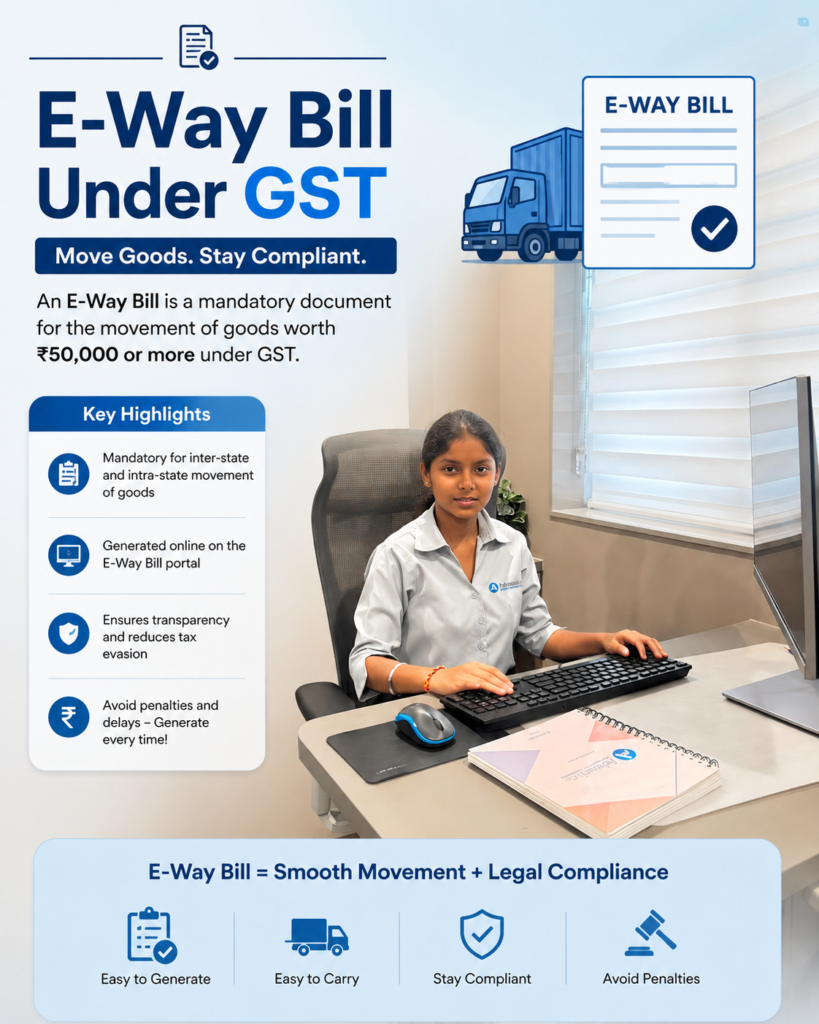
E-Way Bill Under GST
“We’ve registered on the E-Way Bill portal. So now we need an E-Way Bill for every invoice, right?” That was the first question a client asked us after completing their registration. It’s a common assumption and one that trips up even well-run businesses. The truth is that an E-Way Bill under GST is not automatic, and understanding exactly when one is required can save a business from unnecessary compliance headaches.
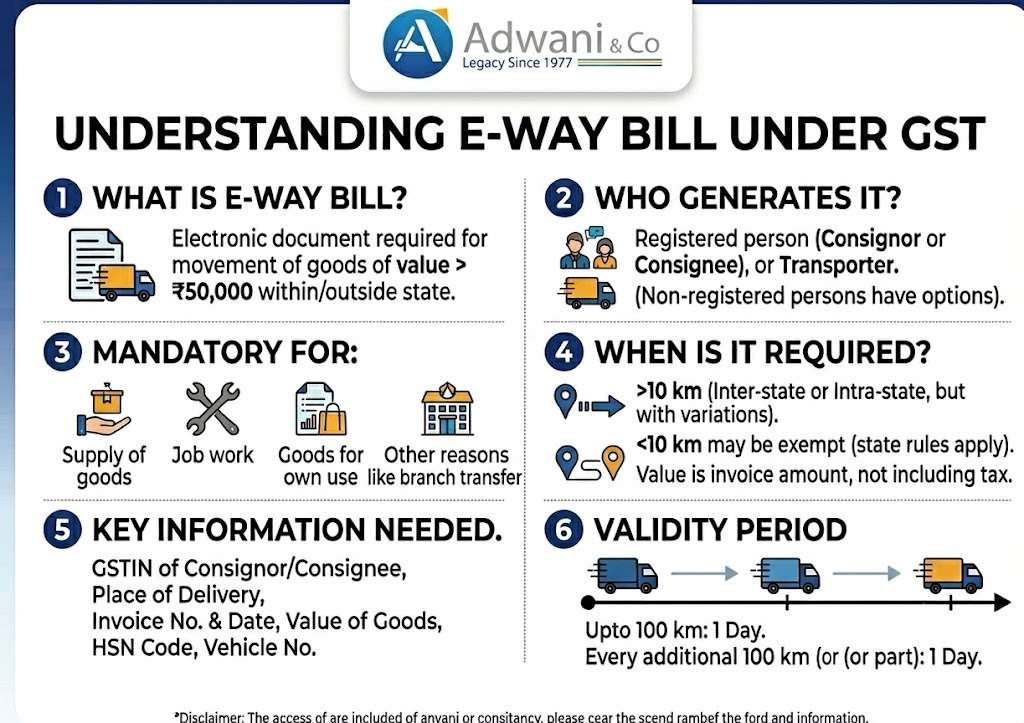
What Registering for an eWay Bill Under GST Actually Means
As this client’s business grew, more of their consignments began crossing the prescribed value threshold. It was the right moment to register using their GSTIN so they could generate an eWay Bill under GST whenever the law required it.
Our answer to their question surprised them: registration does not mean every invoice needs an E-Way Bill. Registration simply enables a business to generate one whether an E-Way Bill under GST is actually required depends entirely on the nature of the transaction and the applicable provisions.
The Four Questions That Decide If an eWay Bill Under GST Is Needed
Before generating an E-Way Bill under GST for any consignment, we always work through the same four questions with our clients:
- Is there an actual movement of goods involved in the transaction?
- Does the consignment value exceed the prescribed limit generally ₹50,000, subject to state-specific notifications?
- Is the movement covered under any notified exemption?
- Who is responsible for generating the E-Way Bill the supplier, the recipient, or the transporter?
Getting a clear answer to each of these before goods move is what separates smooth GST compliance from last-minute scrambling.
A Common Misconception About eWay Bill Under GST Registration
One of the biggest misconceptions businesses have is assuming that GST registration itself automatically enables E-Way Bill generation. It doesn’t. A business must complete a separate registration on the E-Way Bill portal before it can generate an E-Way Bill under GST for any consignment the two systems are linked but not the same.
This distinction is laid out clearly on the official eWay Bill portal, which operates as a separate registration layer connected to a business’s GSTIN rather than an automatic extension of it.
The 180-Day Rule Every Business Should Know
Another compliance point that catches businesses off guard: under the current provisions, an eWay Bill under GST cannot be generated for an invoice older than 180 days. Delayed action on eligible consignments can therefore create compliance challenges that are entirely avoidable with timely tracking.
“Most GST compliance issues we see don’t come from businesses ignoring the law,” says Dr. Haresh Adwani, Founder of Adwani & Co LLP and a PhD holder in Commerce with a law degree. “They come from businesses misunderstanding exactly when the law applies to their specific transaction and the eWay Bill under GST is one of the clearest examples of that gap.”
A Practical Example: When an eWay Bill Under GST Applies
Consider a manufacturer dispatching goods worth ₹65,000 to a buyer in another state. Since the consignment value exceeds the ₹50,000 threshold and involves movement of goods, an eWay Bill under GST is required before the vehicle leaves the premises. Now compare that to the same manufacturer sending a sample consignment worth ₹8,000 here, because the value falls below the threshold, an E-Way Bill under GST is typically not required, provided no other notified condition applies.
This is exactly the kind of transaction-by-transaction judgement that registration alone does not resolve. “Registering on the portal is only step one,” adds Dr. Haresh Adwani. “The real compliance work is in evaluating each consignment against the value threshold, the exemption list, and who bears responsibility for generating the document.”
Read our detailed guide on: GST Composition Scheme: A Complete Guide for Small Businesses
Key Takeaway An eWay Bill under GST is not generated automatically just because a business is registered on the eWay Bill portal. It is required only when goods move, the consignment value exceeds the prescribed threshold (generally ₹50,000), and no exemption applies and it cannot be generated for invoices older than 180 days.
How Adwani & Co LLP Helps With eWay Bill Under GST Compliance
At Adwani & Co LLP, a Pune-based chartered accountancy practice founded in 1977, we regularly guide growing businesses through E-Way Bill portal registration, threshold assessment, and day-to-day GST compliance. Under the guidance of Dr. Haresh Adwani PhD (Commerce) and LLB our team helps clients build simple internal checklists so that E-Way Bill under GST decisions are made correctly before goods ever leave the warehouse.
Learn more about our GST Compliance Advisory Services, or read our detailed guide on Responding to GST ITC Notices for a closer look at how documentation gaps like these can escalate into departmental scrutiny.
Q. Does GST registration automatically allow me to generate an E-Way Bill?
A. No. GST registration and E-Way Bill registration are two separate steps. Even after obtaining a GSTIN, a business must register independently on the E-Way Bill portal before it can generate an Way Bill under GST for any consignment.
Q. Is an E-Way Bill under GST required for every invoice?
A. No. An E-Way Bill under GST is required only when there is a movement of goods and the consignment value exceeds the prescribed threshold, generally ₹50,000, subject to specific state notifications and exemptions.
Q. Who is responsible for generating the E-Way Bill the supplier, recipient, or transporter?
A. Responsibility depends on who causes the movement of goods and the terms of the transaction. In practice, it can fall on the supplier, the recipient, or the transporter, so this should be clarified before goods move, not after.
Q. Can an E-Way Bill under GST be generated for an old invoice?
A. No. Under current provisions, an E-Way Bill cannot be generated for an invoice that is more than 180 days old, which makes timely action essential to avoid unnecessary compliance complications.
Q. What happens if goods move without a valid E-Way Bill under GST?
A. Movement of goods without a valid E-Way Bill under GST, where one was required, can lead to detention of goods and vehicles, along with penalties under the GST law, making it important to verify applicability before dispatch.
Conclusion: Get Your eWay Bill Under GST Decisions Right the First Time
Most GST compliance issues don’t arise because businesses ignore the law they arise because businesses misunderstand exactly when the law applies. Registering on the E-Way Bill portal is an important first step, but it doesn’t answer the real question for every invoice: does this specific consignment need an E-Way Bill under GST or not?
In Part 2 of this series, we’ll walk through some of the most common E-Way Bill mistakes we see in practice including one assumption that nearly caused a compliance issue for this very client. If your business is unsure how E-Way Bill under GST rules apply to your transactions, don’t wait for a mistake to find out. Connect with Adwani & Co LLP today for a practical compliance review.
About the Author: Sejal Kadam
Sejal Kadam is an Indirect Tax Associate at Adwani & Co LLP with a strong interest in GST, indirect taxation, and regulatory compliance. She contributes to helping businesses navigate evolving tax laws through practical, research-backed insights. Through her articles, Sejal aims to simplify complex GST and compliance topics, enabling businesses and professionals to make informed decisions with confidence.
Disclaimer
This article is prepared for general informational and educational purposes only and does not constitute professional tax, legal, or financial advice. GST provisions, including eWay Bill requirements, depend on individual facts and applicable state notifications; readers should consult a qualified chartered accountant or tax professional, such as the team at Adwani & Co LLP, before acting on any information contained herein.