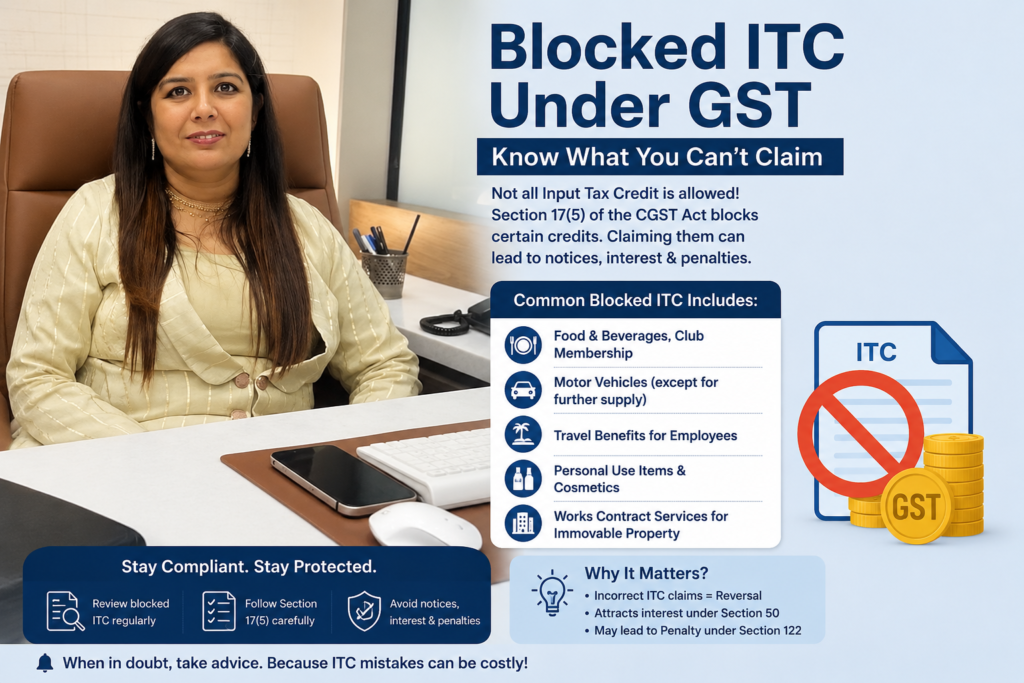
Blocked ITC Under GST
A manufacturing company recently renovated its corporate office. It paid GST on premium furniture, decorative lighting, employee lounge interiors, and cafeteria upgrades. Since GST appeared correctly on every invoice, the finance team assumed the entire Input Tax Credit was available. During a routine GST review, they discovered that a significant portion of that credit was blocked ITC under GST, disallowed under Section 17(5) of the CGST Act. The result: additional tax outflow, interest, and avoidable litigation. This is one of the most common and costly misconceptions in GST compliance today.
What Is Blocked ITC Under GST? Understanding Section 17(5)
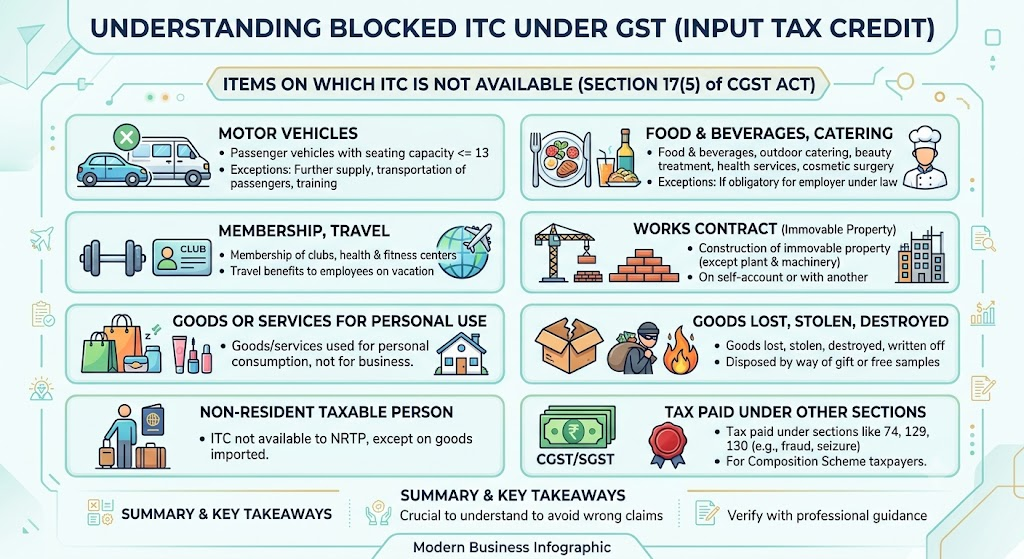
Blocked ITC under GST refers to input tax credit that a business is legally barred from claiming, even though GST was correctly charged and paid on the underlying purchase. Section 17(5) of the CGST Act operates as a negative list: if an expense falls into one of its listed categories, the credit is disallowed regardless of whether the expense genuinely serves the business.
This is the single biggest misunderstanding finance teams carry into GST filing season. Paying GST on an invoice is not the test for eligibility. Whether the expense appears on the blocked ITC under GST list is the test that actually matters.
Common Categories of Blocked ITC Under GST
Some of the most frequently disallowed items under blocked ITC under GST provisions include:
- Food and beverages, outdoor catering, and health or beauty treatments (subject to limited exceptions)
- Club memberships, health clubs, and fitness centre subscriptions
- Motor vehicles and other conveyances for passenger transport, except where specifically permitted
- Works contract services and goods or services used for construction of immovable property
- Goods or services used for personal consumption rather than business purposes
- Employee travel benefits such as leave travel concession and holiday packages
- Goods lost, stolen, destroyed, written off, or given away as free samples or gifts
Each of these categories exists in the blocked ITC under GST framework specifically to prevent revenue leakage and stop businesses from using the credit mechanism for expenses that are personal, discretionary, or capital in nature.
Real Example: How Office Renovation Triggers Blocked ITC Under GST
Consider a company that spends ₹40 lakh renovating its head office, including ₹12 lakh on furniture, ₹5 lakh on decorative lighting, ₹6 lakh on an employee lounge, and ₹17 lakh on structural civil work and cafeteria upgrades.
GST paid on the entire ₹40 lakh may appear claimable at first glance. In reality, the works contract and construction-of-immovable-property portions (broadly the ₹17 lakh civil work) fall squarely under blocked ITC under GST because Section 17(5)(c) and (d) disallow credit on construction, except where the expenditure qualifies as plant and machinery. The decorative lighting and lounge interiors attached to the building structure may also be denied on the same ground. Only clearly movable, business-use assets such as standalone furniture may remain eligible, subject to proper documentation.
Key Distinction
- Paying GST on an invoice does not automatically make the credit eligible.
- Blocked ITC under GST applies even when the expense is genuinely used for business.
Construction of immovable property is blocked except for qualifying plant and machinery
Blocked ITC Under GST vs Eligible ITC: The Key Test
Before claiming any credit, businesses should run every expense through three questions to separate genuine ITC from blocked ITC under GST:
- Is the expense incurred in the course or furtherance of business?
- Is the credit specifically blocked under Section 17(5) of the CGST Act?
- Does the business hold the required documentation and satisfy all conditions under GST law?
If the answer to the second question is yes, no amount of business justification restores the credit. Blocked ITC under GST overrides the general eligibility rule.
How to Identify Blocked ITC Under GST Before You File
1: Map Every Expense Category Against Section 17(5)
Review purchase registers line by line against the Section 17(5) list rather than relying on GST appearing on the invoice.
2: Cross-Check GSTR-2B for Ineligible Flags
The auto-drafted ITC statement on the GST Portal separates eligible and ineligible credit, making it a useful cross-check against your books.
3: Reverse Ineligible Credit in GSTR-3B
Where blocked ITC under GST has already been claimed in error, it must be reversed in Table 4(B) of GSTR-3B along with applicable interest.
4: Build a Periodic GST Review Process
A proactive quarterly review of high-value purchases, especially capital expenditure and employee benefit spends, prevents blocked ITC under GST issues from accumulating into a year-end surprise.
Consequences of Wrongly Claiming Blocked ITC Under GST
- Interest liability on the reversed credit from the date of claim
- Departmental scrutiny and GST notices for incorrect ITC claims
- Penalty exposure where the claim is treated as suppression of facts
- Working capital strain from unplanned tax outflow during reversal
Expert Guidance on Blocked ITC Under GST Compliance
GST compliance today involves accounting precision as much as legal interpretation, particularly where blocked ITC under GST rules intersect with capital expenditure and employee benefits. Dr. Haresh Adwani, PhD (Commerce) and a law graduate, brings this combined expertise to help businesses correctly classify expenses before they become blocked ITC under GST liabilities.
At Adwani & Co LLP, businesses receive a structured pre-filing review of high-value purchases, renovation spends, and employee benefit expenses to identify blocked ITC under GST exposure before it becomes a departmental notice.
Guidance available on the GST Portal and clarifications from the Ministry of Corporate Affairs reinforce why businesses increasingly rely on structured professional review rather than assuming every GST-paid invoice is creditable. As Dr. Haresh Adwani often notes, GST compliance is not just about claiming credits it is about claiming the right credits.
Learn more about our GST Advisory & ITC Review Services. Read our detailed guide on GST Notice Compliance for Businesses.
Key Takeaways on Blocked ITC Under GST
- Blocked ITC under GST applies even when the expense is genuine and business-related.
- Food, club memberships, motor vehicles, construction, and employee travel benefits are commonly blocked.
- Cross-check every claim against Section 17(5) before filing, not after a departmental notice.
Reverse ineligible credit promptly in GSTR-3B to limit interest exposure.
1.What is blocked ITC under GST?
Blocked ITC under GST refers to input tax credit that cannot be claimed under Section 17(5) of the CGST Act, even though GST was correctly paid on the purchase.
2.Is ITC on office renovation always blocked?
ITC on works contract services and construction of immovable property is generally blocked, except where the expenditure qualifies as plant and machinery.
3.Can businesses claim ITC on employee food and travel benefits?
Generally no. Food, beverages, and employee travel benefits such as leave travel concession fall under blocked ITC under GST unless mandated by law.
4.What happens if blocked ITC is claimed by mistake?
It must be reversed in Table 4(B) of GSTR-3B along with applicable interest, or it may attract penalty and departmental scrutiny.
5.Is ITC available on motor vehicles under GST?
ITC on motor vehicles is blocked unless the vehicle is used for permitted purposes such as further supply, passenger transport services, or driver training.
6.Where can I check which purchases have ineligible ITC?
The GSTR-2B auto-drafted statement on the GST Portal separates eligible and ineligible ITC for each return period.
Conclusion: Claim the Right Credits, Not Just Available Credits
Blocked ITC under GST catches even well-run finance teams off guard because the invoice itself gives no warning. The safeguard is a disciplined, expense-by-expense review against Section 17(5) before every filing, not a reactive reversal after a departmental notice.
About the Author
Nidhi Adwani is the Human Resources Manager at Adwani & Co. She is a Law Graduate and holds an MBA in Human Resources. She manages recruitment, employee engagement, team development, workplace culture, and the firm’s social media and content activities. Passionate about people and organizational growth, she also contributes articles for ITRAdvisor and Adwani & Co. Her writing focuses on HR practices, leadership, workplace engagement, and professional development, offering practical insights for professionals and businesses.
If you want expert guidance on blocked ITC under GST and a documented review of your ITC position, connect with Adwani & Co LLP today.
Legal Disclaimer: This article is published for informational and educational purposes only. Nothing contained herein constitutes legal, financial, or tax advice, nor should it be treated as a substitute for professional consultation tailored to your specific circumstances. Tax laws, rates, and provisions are subject to change; readers are strongly advised to consult a qualified Chartered Accountant or tax advisor before acting on any information in this article.
All content is original. References to government portals and statutory provisions are paraphrased for educational purposes in compliance with fair use principles. No content has been reproduced from third-party sources